What Class Warfare Looks Like


Mike Konczal has a rough transcript, starting about 45 seconds in:

Representative Barca:  Excuse me, Mr. Chairman I have a question about the open meeting rule being violated…Most importantly, before we even get started, obviously I’m going to want to have a summary of this bill from our director Lane, so I understand what’s in here.

Chairman:  It’s the same bill you debated for 60 hours.

Barca:  So there’s nothing different?

Chairman:  No.  We just removed items from it.

Barca:  Removed what?

Chairman:  Removed items.  There’s nothing new.

Barca:  So can we get a description of what was removed?

Chairman:  Nothing new.

Barca:  Well, you said things were removed Mr. Chairman.  I want to know what’s removed.  It seems to me that the body should have and our community should know what we are voting on.  So what was removed?  I need to know that.  So I do want a description from Director Lane….But before we even get into that I want this is a violation of the open meeting law.  It is required, I have here a memo from the current Attorney General, not a past one the current one.  August 2010.  No Wisconsin Court decision will allow meetings unless you have good cause to provide less than 24 hours notice of a meeting.   The provision, like all other provisions of the open meetings law must be construed in favor of providing the public with the fullest and most complete information about government affairs…

Chairman:  Representative Barca.

Barca:  that’s compatible with government business…

Chairman:  Representative Barca.  Clerk, call roll.

Barca:  NO EXCUSE ME  It says if there’s any doubt as to whether or not good cause exists the governmental body should provide 24 hours notice. This is clearly a violation of the open meetings law.  You have been shutting people down…

Members:  Aye.

Last night was as clear an example as any I’ve ever seen of how Republicans are waging class war on the American middle class. As Rep. Barca points out, what the happened in Wisconsin during last night’s conference committee meeting clearly violated the state’s open meetings law, which require 24 hour notice prior to a governmental meeting. David Dayen has been astutely documenting the ways in which how the WI Senate Republicans split off the repeal of collective bargaining to make it “non-fiscal” (despite arguing for a month that it was a fiscal provision) failed to actually remove fiscal items from the language they voted on:

But that does not address the potential fiscal impact in what remained. On page 12 of the LFB memo you see a item that would “reduce funding… in the Joint Committee on Finance’s general program revenue supplemental appropriation.” On page 17, you see the changes to public employee health and pension benefits. On page 33, there’s an inclusion of a particular piece of wetlands in a tax incremental financing district, which appears to be tax relief. It would be hard to imagine that these pieces don’t have a fiscal impact. In fact, the Wisconsin State Journal, one of the more staid publications in the state, basically came this close to accusing the Republicans of outright lying

One of the Wisconsin 14 Democratic State Senators who’ve bravely stayed away for the last number of weeks and created the delay that allowed protests to gather steam did in fact go so far as to call Governor Walker a liar last night on MSNBC (sorry I don’t have the quote). State Senate Minority Leader Mark Miller had this to say after the Republicans dishonest and dishonorable actions yesterday:

“In thirty minutes, 18 State Senators undid fifty years of civil rights in Wisconsin.

“Their disrespect for the people of Wisconsin and their rights is an outrage that will never be forgotten.

“Tonight, 18 Senate Republicans conspired to take government away from the people.

“Tomorrow we will join the people of Wisconsin in taking back their government.”

The solidarity between Wisconsin Democrats, unionized workers of both the public and private sector, students and the general public has been truly inspiring. It will continue in the face of this latest assault and I can’t imagine anything but a further slide in approval for Gov. Scott Walker and the Republicans in Madison who rammed this bill through over unprecedented public opposition.

Nate Silver on the strength of the GOP field

Nate Silver of FiveThirtyEight at the Times has a very interesting and typically numbers-rich post looking at the comparative strength of the 2012 Republican presidential candidates, as compared to the strength of past primary fields.

So it does look like Republicans have some legitimate reason to worry. In the previous five competitive primaries — excluding 2004 for the Republicans, when Mr. Bush won re-nomination uncontested — each party had at least two candidates whose net favorability ratings were in the positive double digits, meaning that their favorables bettered their unfavorables by at least 10 points. All five times, also, the nominee came from among one of the candidates in this group. Republicans have no such candidates at this point in time.

Meanwhile, the Republicans have two candidates in Ms. Palin and Mr. Gingirch whose net favorability ratings are actually in the double-digit negatives, something which since 2000 had only been true of Pat Buchanan and Al Sharpton.

Mike Huckabee is +8 and Mitt Romney is +4 with their favorability ratings. Thune, Daniels, DeMint, Pawlenty, and Barbour all have 0 to -3 ratings, but none have raw favorable nor unfavorable ratings above 20%, so there’s clearly room for them to grow in either direction.

At bottom Silver’s analysis suggests that this is not a strong field of candidates at this point in time. Much of the field would presumably benefit from voters getting to know them better, though that won’t necessarily help unless they’re actually decent candidates. Just ask Sarah Palin how people getting to know her has worked out.

A Night of Contrast

Jonathan Singer is right to say that last night’s State of the Union did the job for President Obama, in that it laid out clear contrast between him and the Republican Party.

If I was struck by anything, it was that Barack Obama set the stage to come off as unreasonable [sic] as his political adversaries look unreasonable. From healthcare to spending to education, the President appeared willing to deal with Republicans unwilling to deal. This not only makes it easier for the President to win reelection — generally, the reasonable candidate is going to win over the unreasonable one — it will also make it easier for him to win the political battles that are almost assured to arise over the next two years out of the Congress, starting with a government shutdown that many expect to occur.

I think this is right. While the speech didn’t do a whole lot to energize me as a progressive activist, I think it really helped make the President stand apart from what the Republicans are selling: divisiveness, conflict, obstruction. If the lame duck session was any indication, the President will be able to paint Republicans into a corner that they do not want to be in and move his agenda as a result. The drawback is that this agenda will be more determined by political optics than policy necessity or ideology. If the President’s primary goal is reelection, he’s well positioned to beat the midgets of the Republican Party. The question is, will political maneuvering result in enough getting done to make optics and posture instructive in voters minds? Or will the net result of this maneuvering have to be an improved economy with more jobs and lower unemployment, which will likely be even more palatable to voters than mere contrast? Drawing contrast is critical to winning elections, but I don’t know if it is enough in itself. Unless, that is, the GOP nominates someone like Sarah Palin.

The Right’s Field

In 2006 I started a site called The Right’s Field (now offline) with my friends Kombiz Lavasany and Matt Ortega. We wanted to have a place that was dedicated solely to covering the 2008 Republican presidential primary. While many liberal blogs covered the 2008 Democratic primary in full or had the occasional post about Republicans, no one was working exclusively on blogging the GOP race. We filled that role and along the way had other great writers contribute to it, including David Dayen, Todd Beeton, Michael Roston and others.

Kombiz, Matt and I recently decided that we should start up The Right’s Field again. We approached John Amato and Joe Sudbay of AMERICAblog and they offered to give us our own space on their site. It’s been in soft launch for the last week or so, but is now public today. You can check out AMERICAblog Elections: The Right’s Field at elections.AMERICAblog.com. My first post is here.

I’ll likely cross-post some content from The Right’s Field here, but probably won’t do everything, so stay tuned over at <a href="http://elections.americablog.com/&quot;.

Derived from the far right

The Los Angeles Times:

Most wind up concluding that Loughner suffered from mental problems. But experts said that several oft-repeated phrases and concepts — his fixation on grammar conspiracies, currency and the “second United States Constitution” — seem derived from concepts explored with regularity among elements of the far right.

“What you can see across the board in his writings is the idea that you can’t trust the government — that the government engages in mind control against its citizens,” said Mark Potok of the Southern Poverty Law Center, which has long monitored the radical right.

Loughner’s assertion that he would not “pay debt with a currency that’s not backed by gold and silver” is a running theme among right-wing opponents of the Federal Reserve system.

Disingenuous

George Packer:

But it won’t do to dig up stray comments by Obama, Allen Grayson, or any other Democrat who used metaphors of combat over the past few years, and then try to claim some balance of responsibility in the implied violence of current American politics. (Most of the Obama quotes that appear in the comments were lame attempts to reassure his base that he can get mad and fight back, i.e., signs that he’s practically incapable of personal aggression in politics.) In fact, there is no balance—none whatsoever. Only one side has made the rhetoric of armed revolt against an oppressive tyranny the guiding spirit of its grassroots movement and its midterm campaign. Only one side routinely invokes the Second Amendment as a form of swagger and intimidation, not-so-coyly conflating rights with threats. Only one side’s activists bring guns to democratic political gatherings. Only one side has a popular national TV host who uses his platform to indoctrinate viewers in the conviction that the President is an alien, totalitarian menace to the country. Only one side fills the AM waves with rage and incendiary falsehoods. Only one side has an iconic leader, with a devoted grassroots following, who can’t stop using violent imagery and dividing her countrymen into us and them, real and fake. Any sentient American knows which side that is; to argue otherwise is disingenuous.

The Tree of Liberty

Alex Pareene has a good piece over at Salon. Pareene writes:

The Tea Parties are based around the rhetoric of the American Revolution, which was a violent insurrection. It makes a sad sort of sense that a bunch of comfortable white reactionaries would dress up their childish tantrums with such grandiose language, because “desperately protecting your privilege in the face of what appears to be the demise of the empire” sounds much less inspiring than “defeating tyranny.”

As the Republican Party has become more homogeneous, more regional, and more reactionary, they have tended to make up for their growing demographic shortcomings by making sure their supporters are more motivated and energized — and the most effective way to energize them has been to make sure they’re constantly enraged.

When the GOP didn’t have the votes to stop healthcare reform from passing, their strategy — and it almost worked — was to scare Democratic elected officials. That was the point of telling everyone to shout themselves hoarse at the town halls: to terrify House members. Convince them that their constituents were incensed. If some LaRouchites or other unclassifiable political entities got into the mix, fine — more voices for the choir of rage. What was formerly a sort of uneasy tolerance of the extremists inched closer to open acceptance. Roger Ailes allows Glenn Beck to run amok spreading classic Bircher paranoia. Matt Drudge links to conspiracy-mad broadcaster Alex Jones. Everyone in the party had to pretend to be cool with idiot extremist Oath Keeper Sharron Angle, because the craziness the right-wing whipped up led their primary voters to select her over the safe party hack who would’ve handily defeated Harry Reid. There are connections — both direct and spiritual — between the far-right Patriot movements that flourished in the ’90s and some of the more out there elements of the Tea Parties.

When everyone’s hoisting guns and shouting “tyranny” and playing at being a revolutionary, there will be a couple people who don’t see the wink.

I think the simple reality is this: if Republicans had an ideology and a substantive, positive policy agenda that was greater than speeding up the transfer of wealth from working Americans to the richest 1% of Americans, they would run on that. But they don’t. So instead they stomp their feet about incremental policy reforms to things like health care and the finance industry that, at most, at a patina of liberalism to the status quo without substantially changing things one iota. They talk about these small changes as socialism, as communism, and as tyranny, exhorting their audiences to be their own little Patrick Henrys.

Again, were the Republican Party not so devoid of palatable ideas, they would not have to use violent and extreme rhetoric to drum up enthusiasm for the public. But they’re afraid to talk honestly about their agenda of class warfare on behalf of Wall Street. Surely this reality would be hilariously embarrassing for Republicans, if they had any shame. We know they don’t, again as evidenced by their absurdly extreme opposition to a health care bill effectively cloned from that proposed by a leading 2008 Republican presidential candidate. In the end, there shouldn’t merely be calls for Republican leaders to cease using violent rhetoric in their opposition to Democrats, but instead that call for cessation should be accompanied by a call for for Republicans to finally talk honestly about the things they do support and why they support them, without the trappings of Revolutionary War rhetoric and regalia.

Assassination in Arizona

I haven’t posted earlier for two reasons – first, there’s still a lot of information and insight coming out of the investigation in Arizona. Second, the pace of rapid fire punditry was somewhat overwhelming. At a certain point, while people are still in surgery, I don’t really care to be arguing with conservatives on Twitter about the level of their leaders’ culpability for their persistently violent rhetoric in opposition to the Obama administration and Democratic policy pursuits.

The press and public figures may not be willing to admit it, but violence has been a hallmark of American politics since our country’s inception. While over the course of our history violence has been perpetrated to further political means by both sides of the political spectrum, over the last hundred years (at least) conservatives have been far more likely to use violence as a means of political expression. From the Oklahoma City bombing to the murder and lynching of countless civil rights activists (or random African-Americans) during the Civil Rights era, the American right has a real, terrifying history of using violence. It is this history that makes the comments by Republican figureheads like Sarah Palin, Glenn Beck, Sharron Angle and Michele Bachmann so dangerous. The rhetoric exists in a historical context that is marred by violence.

In many regards, the violent rhetoric that we see realized in Tucson started with President Obama’s inauguration and the legislative process of reforming health care. The August 2009 recess was defined by the frequent disruptions of town hall discussions by Tea Party radicals. Many town halls were canceled because of threats made against legislators. The threats weren’t solely directed at people making policy – many organizations that supported the President and reform, including my own labor union – were inundated with threats of violence from conservatives.  One Glenn Beck viewer became so inspired by Beck’s smears of the non-profit Tides Foundation that he took up arms and drove to Oakland to try to kill them all, only to end up in a fire fight with the police.

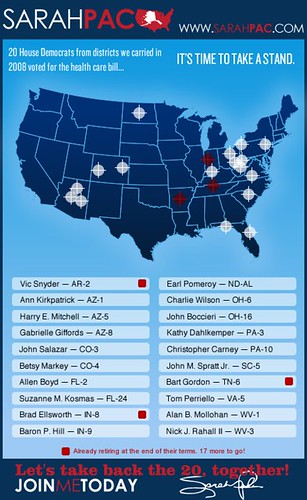
A lot has been made that Rep. Gifford was one of the Democrats literally put in the crosshairs by Sarah Palin’s PAC. Gifford herself thought that it was provocative and dangerous, telling MSNBC “they’ve gotta realize there are consequences to that action.” Of course, Palin and her staff immediately tried to scrub references to the target map after the shooting. One spokesperson even went so far as to suggest the scope crosshairs were not even targets.

In fact, she said that the “target list” was not intended to allude to guns.

“We never ever, ever intended it to be gun sights,” she said.

“It’s surveyor’s symbols,” the interviewer Tammy Bruce suggested. Bruce, a Palin supporter, describes herself as “a gay, pro-choice, gun owning, pro-death penalty, Tea Party Independent Conservative. ” Her show is promoted as a “chick with a gun and a microphone.”

Mansour agreed. She said that the graphic was contracted out to a professional. They approved it quickly without thinking about it. “We never imagined, it never occurred to us that anybody would consider it violent,” she said. Rather, she said, that it was simply “crosshairs that you would see on a map.”

There is “nothing irresponsible about our graphic,” she said.

I am hard pressed to think of a single statement in American politics that is more outrageous and dishonest than this. Even Sarah Palin thinks the target symbols were target symbols, saying in a tweet:

@SaraPalinUSA Remember moths ago “bullseye” icon used 2 target the 20 Obamacare-lovin’ incumbent seats? We won 18 out of 20 (90% success rate;T’aint bad)

As I said, I can’t think of a more dishonest, outrageous statement in recent political history than Palin’s spokesperson saying these were surveyor marks and not bullseye targets. If they were in fact a surveyor or mapping symbol, then Palin would not refer them to as “bullseye icon[s]” and her staff would not be scrubbing the internet of that image and those tweets. Beyond this, Dave Weigel points out that Palin repeatedly doubled down on the target map throughout the 2010 campaign. Any suggestion to the contrary is completely ludicrous.

The fact that we are even in a position where the leading public figure of one political party has to deny that her words and her imagery actually encouraged violence is a testament to how outlandish Palin’s rhetoric was to begin with. But as bad as she has been, she is hardly the sole perpetrator of violent rhetoric on the right. It is disturbingly ubiquitous from leaders on the right, especially as the Tea Party has risen as a power base within the GOP. Something is deeply wrong when the language of violence is used to create enthusiasm for one political party, due to unhappiness with the previous results at the ballot box. When words like traitor, socialist, fascist, and communist are tossed around as needs for Republicans to “take our country back” and use “Second Amendment remedies” to achieve their goals, it is not shocking that some of their followers eventually do take up arms.

Yesterday Paul Krugman blogged:

You know that Republicans will yell about the evils of partisanship whenever anyone tries to make a connection between the rhetoric of Beck, Limbaugh, etc. and the violence I fear we’re going to see in the months and years ahead. But violent acts are what happen when you create a climate of hate. And it’s long past time for the GOP’s leaders to take a stand against the hate-mongers.

Pima County Sheriff Clarence W. Dupnik gave a soul-searching press conference yesterday (quotes from an emailed transcript & this story):

“When you look at unbalanced people, how they respond to the vitriol that comes out of certain mouths about tearing down the government. The anger, the hatred, the bigotry that goes on in this country is getting to be outrageous. And, unfortunately, Arizona I think has become sort of the Capital. We have become the Mecca for prejudice and bigotry.””It’s not unusual for all public officials to get threats constantly, myself included. And that’s the sad thing of what’s going on in America. Pretty soon, we’re not going to be able to find reasonable, decent people who are willing to subject themselves to serve in public office.”

“It’s time to do a little soul searching about the rhetoric we hear on the radio, how are children are being raised,” the sheriff said.

Republicans are calling for Sheriff Dupnik to resign over these comments, citing fears that they will prompt violence against the right. This would be remarkable if it weren’t entirely within the playbook of the modern Republican Party – attack your opponent where you are most weak.

There is still a tremendous amount of information that will come out about the motives of John Loughner. There is no scenario wherein someone takes a gun into a crowded political event and starts shooting that doesn’t involve them being mentally sick. But putting a gun to the head of a congresswoman point-black and pulling the trigger is an inherently political act. Regardless of what the final answer, if one emerges, about Loughner’s motivations, there is simply no reason for leading Republicans and media figures not to follow Sheriff Dupnik’s advice and do their own soul searching and tone down their rhetoric.

Boehner’s Social Safety Net

Matt Taibbi on Olbermann:

But in Boehner’s case, what’s so funny about it [the people who deserve a social safety net], is the people who can’t compete, I think, in his eyes are, if you go by his TARP vote, it’s JP Morgan Chase and Goldman Sachs and Bank of America. I mean, those are the people he’s talking about when he talks about a social safety net.

Taibbi has a full profile of Boehner in Rolling Stone.

The Texas FAIL

Paul Krugman’s column on the failure of the state of Texas as an incubator of Republican economic ideas is a good one.

Wasn’t Texas supposed to be thriving even as the rest of America suffered? Didn’t its governor declare, during his re-election campaign, that “we have billions in surplus”? Yes, it was, and yes, he did. But reality has now intruded, in the form of a deficit expected to run as high as $25 billion over the next two years.

And that reality has implications for the nation as a whole. For Texas is where the modern conservative theory of budgeting — the belief that you should never raise taxes under any circumstances, that you can always balance the budget by cutting wasteful spending — has been implemented most completely. If the theory can’t make it there, it can’t make it anywhere.

Oh, and at a time when there’s a full-court press on to demonize public-sector unions as the source of all our woes, Texas is nearly demon-free: less than 20 percent of public-sector workers there are covered by union contracts, compared with almost 75 percent in New York.

Right now, triumphant conservatives in Washington are declaring that they can cut taxes and still balance the budget by slashing spending. Yet they haven’t been able to do that even in Texas, which is willing both to impose great pain (by its stinginess on health care) and to shortchange the future (by neglecting education). How are they supposed to pull it off nationally, especially when the incoming Republicans have declared Medicare, Social Security and defense off limits?

People used to say that the future happens first in California, but these days what happens in Texas is probably a better omen. And what we’re seeing right now is a future that doesn’t work.

This is some really scary stuff. Krugman’s column has a whiff of schadenfreude to it, which would be understandable if the consequences of what is happening in Texas to working families weren’t so dire. Having a burning example of the failure of conservative economic theories is useful, but only if policy makers can look at it and change their course. For Texas, I doubt that is likely.

What we’re seeing at the state level in places like Texas, New Jersey, Wisconsin, Ohio, and New York isn’t terribly different from what we hear from conservatives in Washington. Evidence of failure is routinely ignored, as conservative dogma wins the day.  Watching the state-level train wreck in slow motion is more evidence of how hard it is to change policy makers minds with evidence of the failures of their ideas. Above all else, this is what makes me think the mountain we have to climb to get our country out of economic morass defined by pain felt by working American families remains as high as it ever was.

***

On an unrelated note, I just looked and realized my last fifteen posts were tagged in the Economy section. Funny. I guess this is what I want to be writing about now, or something.