Sesame Street introduces poverty-stricken, hungry Muppet

A sign of the times:

A new poverty-stricken Muppet will highlight the issue of hunger struggles on an episode of “Sesame Street”, the show said in a statement on Tuesday.

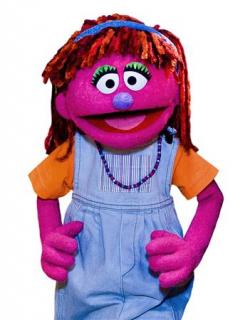
Pink-faced Muppet Lily, whose family deals with food insecurity, will join Big Bird, Elmo and other favorites on a one-hour prime-time special featuring country star Brad Paisley and his wife Kimberly Williams Paisley called “Growing Hope Against Hunger,” to air Oct 9.

The new Muppet will bring awareness to the ongoing hunger struggles that families face in the United States, the show said.

This is a good reminder that culture is deliberate. Whether it’s creating prominent gay characters who have real romantic relationships (with actual kissing!) or a Muppet that highlights how many American families are starving, television show and film writers make conscious choices about what story lines to include. These things don’t just happen on their own. So when these writers and producers make choices which will influence our national culture and create awareness and, hopefully, equality, they should be celebrated. Good job, “Sesame Street”!

Report: government new of mortgage modification failures and did nothing

Paul Kiel at ProPublica reports on the failures of the Obama administration’s Home Affordable Modification Program to conduct oversight and hold banks accountable for following the program’s rules. A snippet:

Documents obtained by ProPublica — government audit reports of GMAC, the country’s fifth-largest mortgage servicer — provide the first detailed look at the program’s oversight. They show that the company operated with almost no oversight for the program’s first eight months. When auditors did finally conduct a major review more than a year into the program, they found that GMAC had seriously mishandled many loan modifications — miscalculating homeowner income in more than 80 percent of audited cases, for example. Yet, GMAC suffered no penalty. GMAC itself said it hasn’t reversed a single foreclosure as a result of a government audit.

The documents also reveal that government auditors signed off on GMAC loan-modification denials that appear to violate the program’s own rules, calling into question the rigor and competence of the reviews.

Some of the auditors’ mistakes are “appalling,” said Diane Thompson of the National Consumer Law Center, an advocacy group. “It suggests the government isn’t taking the auditing process seriously.”

Via Atrios, who points out “the Obama administration had total control of this.”

Durbin blasts Bank of America

Good stuff from Senator Dick Durbin on Bank of America’s recent decision to add a $5 fee for debit card users.

“It is particularly hard to believe this fee would come from a bank with a track record like Bank of America. After helping to drive our economy off the cliff’s edge in 2008, Bank of America was happy to accept a $45 billion federal bailout for their stupidity, their greed, and their stupidity and it was just as happy to take that money and hand out $3.3 billion in employee bonuses in the same year 2008.”

While I appreciate Bank of America getting ripped apart, Citibank has also added a $15-20 fee and other banks have added $3 fees. All of these banks are gouging their customers to preserve profit margins that they have no intrinsic right to maintain.

Whichever politician really steps out and tries to stop these banks from gouging debit card users will likely have a tremendous amount of support from the pu

Barofsky on TARP’s Third Anniversary

Neil Barofsky, former Special Investigator General of TARP, is highly critical of the program on its third anniversary of TAR:

“While successful in helping to prevent financial Armageddon, on TARP’s third birthday it is apparent that Treasury has failed to deliver on the other core promises that it made to Congress and the American people – that TARP would ‘restore lending’ and ‘preserve homeownership.’ Perhaps even more concerning, the inevitable moral hazard that followed Secretary Paulson and Secretary Geithner’s repeated use of TARP funds to back up their pronouncements that they would not let the largest banks fail has not been adequately addressed by regulatory reform. …

“As a result, the TBTF banks are even larger and more dangerous than ever, and could still hold the taxpayer hostage once again in the next financial crisis. Finally, TARP’s most enduring legacy may be the HISTORICAL DISDAIN with which the American people now hold their government, which I believe has been fueled by Treasury administrating TARP with insufficient transparency and with undue deference to the largest financial institutions.”

Listening to the people at #OccupyWallStreet

Matt Stoller has spent time at #OccupyWallStreet and his post at Naked Capitalism explores what’s happening there, who’s participating and what it means. The whole post is, as always with Stoller, worth reading. But this passage stands out:

What these people are doing is building, for lack of a better word, a church of dissent. It’s not a march, though marches are spinning off of the campground. It’s not even a protest, really. It is a group of people, gathered together, to create a public space seeking meaning in their culture. They are asserting, together, to each other and to themselves, “we matter”.

This is tremendously important, in no small part because while these people are boldly stating the importance of their take on the world, to this point, political and wealthy elites haven’t listened to them. While it is unlikely that these elites will suddenly listen to the complaints about and aspirations for government and the economy from young people and workers, the act of stating their case and expressing their importance is tremendously important. Gideon Rosenblatt wrote about the dangers of not listening earlier this week:

If that happens, if these young people are cowed into submission, or worse, simply ignored by the rest of us in society, then their courage will have been in vain. This promising catalyst that might have helped us all to find the courage to take our own stand, to give voice to our frustrations and work to protect this great country from further excesses of Wall Street — all of this will have been wasted.

These young people deserve our attention and our respect. They need our help in turning their idealism into actual solutions to move our country out of its current state of decline.

I don’t think anyone involved in #OccupyWallStreet is expressing a radical position. It is only radical to the extent that other progressive organizations and liberal individuals fail to lend their support to this movement and leave these people on the outside of accepted debate.. The Transportation Workers Union Local 100 in NYC is lending their support, and the Air Line Pilots Association held a huge march and rally to Wall Street. Other larger unions and community groups are joining as well. These actions validate the people camping out on Wall Street and show that at least some of us are listening to the #OccupyWallStreet movement and showing the participants that their action does have meaning.

Cynicism, Teddy Roosevelet & #OccupyWallStreet

With all the enthusiasm and accompanying nitpicking about #OccupyWallStreet, this passage from Teddy Roosevelt’s speech Citizenship in a Republic strikes me as appropriate:

The poorest way to face life is to face it with a sneer. There are many men who feel a kind of twisted pride in cynicism; there are many who confine themselves to criticism of the way others do what they themselves dare not even attempt. There is no more unhealthy being, no man less worthy of respect, than he who either really holds, or feigns to hold, an attitude of sneering disbelief towards all that is great and lofty, whether in achievement or in that noble effort which, even if it fails, comes second to achievement. A cynical habit of thought and speech, a readiness to criticise work which the critic himself never tries to perform, an intellectual aloofness which will not accept contact with life’s realities—all these are marks, not, as the possessor would fain think, of superiority, but of weakness. They mark the men unfit to bear their part manfully in the stern strife of living, who seek, in the affectation of contempt for the achievements of others, to hide from others and from themselves their own weakness. The role is easy; there is none easier, save only the role of the man who sneers alike at both criticism and performance.

It is not the critic who counts; not the man who points out how the strong man stumbles, or where the doer of deeds could have done them better. The credit belongs to the man who is actually in the arena, whose face is marred by dust and sweat and blood; who strives valiantly; who errs, and comes short again and again, because there is no effort without error and shortcoming; but who does actually strive to do the deeds; who knows the great enthusiasms, the great devotions; who spends himself in a worthy cause; who at the best knows in the end the triumph of high achievement, and who at the worst, if he fails, at least fails while daring greatly, so that his place shall never be with those cold and timid souls who know neither victory nor defeat. Shame on the man of cultivated taste who permits refinement to develop into a fastidiousness that unfits him for doing the rough work of a workaday world. Among the free peoples who govern themselves there is but a small field of usefulness open for the men of cloistered life who shrink from contact with their fellows. Still less room is there for those who deride or slight what is done by those who actually bear the brunt of the day; nor yet for those others who always profess that they would like to take action, if only the conditions of life were not what they actually are. The man who does nothing cuts the same sordid figure in the pages of history, whether he be cynic, or fop, or voluptuary.

Hat tip to Jake on this one.

Liberals should join #OccupyWallStreet, not nitpick

Originally posted at AMERICAblog

John has been posting regularly on #OccupyWallStreet, particularly highlighting the disgusting and brutal NYPD attacks on non-violent protestors. I also highly recommend Sarah Jaffe’s rich and detailed post at Alternet, which does a great job contextualizing why people have been occupying Wall Street for more than 11 days at this point.

But I want to highlight a piece by Glen Greenwald today which goes directly to the criticism many ostensibly progressive people and organizations have levied against the #OccupyWallStreet movement. It’s not shocking that bankers and the mainstream media are dismissive of this expression of popular outrage against the power wealthy elites have over our economy and our political system. This is an expression of anger at the lack of accountability to the needs of the 99% of our citizenry who don’t ge t to buy time with the President at $35,000 a pop. Greenwald writes:

But for those who believe that protests are only worthwhile if they translate into quantifiable impact: the lack of organizational sophistication or messaging efficacy on the part of the Wall Street protest is a reason to support it and get involved in it, not turn one’s nose up at it and join in the media demonization. That’s what one actually sympathetic to its messaging (rather than pretending to be in order more effectively to discredit it) would do. Anyone who looks at mostly young citizens marching in the street protesting the corruption of Wall Street and the harm it spawns, and decides that what is warranted is mockery and scorn rather than support, is either not seeing things clearly or is motivated by objectives other than the ones being presented.

Right on.

And if that isn’t enough, I offer as a reminder the words of one of the women who was assaulted by NYPD officer Anthony Bologna this past weekend:

“I have respect for police officers, but that man assaulted me,” Ms. Elliott said. “Bizarrely. Stupidly. Needlessly.”

In a functional system of justice, this officer would be arrested and charged with assault. I’ll be watching to see if that happens and I suggest you do too.

Yves Smith on Melissa Harris-Perry

Yves Smith at Naked Capitalism responds to Melissa Harris-Perry’s post on The Nation that racism is driving the abandonment of Barack Obama by white liberals. Harris-Perry has been one of the more prominent reflexive defenders of President Obama, but her charge of racism is serious and merits evaluation. Smith does that, as well as connecting her piece to strong criticisms from Brooklyn College professor Corey Rubin and Jon Walker at FireDogLake. Walker points out that Obama doesn’t have a white people problem, he has an everyone problem.

But I’m more interested in Smith’s critique of the core difference in the Democratic Party that create rifts around really big issues, not just identity politics:

The left is obsessed with what ought to be peripheral concerns, namely, political correctness and Puritanical moralizing, because it is actually deeply divided on the things that matter, namely money and the role of the state. The Democrats have been so deeply penetrated by the neoliberal/Robert Rubin/Hamilton Project types that they aren’t that different from the right on economic issues. Both want little regulation of banking and open trade and international capital flows. Both want to “reform” Medicare and Social Security. Both are leery of a welfare state, the Republicans openly so, the Rubinite Dems with all sorts of handwringing and clever schemes to incentivize private companies that generally subsidize what they would have done regardless (note that Americans have had a mixed record in providing good social safety nets, but a big reason is our American exceptionalism means we refuse to copy successful models from abroad).

The powerful influence of moneyed interests on the Democratic party has achieved the fondest aims of the right wing extremists of the 1970s: the party of FDR is now lukewarm at best in its support of the New Deal. Most Democrats are embarrassed to be in the same room with union types. They are often afraid to say that government can play a positive role. They were loath to discuss the costs of income inequality until it became so far advanced that it is now well nigh impossible to reverse it. After all, that sort of discussion might sound like class warfare, and God forbid anyone on the mainstream left risk sound like Marx.

So the Democratic party (and remember, our two party system makes the Democrats the home by default for the left) pretends to be a safe haven for all sorts of out groups: women, gays, Hispanics (on their way to being the dominant group but not there yet), blacks, the poor. But this is stands in stark contradiction to its policies of selling out the middle class to banks and big corporate interests, just on a slower and stealthier basis than the right. So its desperate need to maintain its increasingly phony “be nice to the rainbow coalition” branding places a huge premium on appearances. It thus uses identity politics as a cover for policy betrayals. It can motivate various groups on narrow, specific issues, opening the way for the moneyed faction to get what it wants.

The Democratic coalition, let alone the liberal/progressive movement (such as it is), has huge internal conflicts. The CWA supports a merger between AT&T and T-Mobile, while opposing net neutrality. Progressive leaders like Eric Schneiderman oppose the merger, as do internet freedom activists. A transpartisan spectrum of groups supports net neutrality. It’s OK that these differences exist. But it’s not OK to ignore them and their implications. As Smith points out, things get even more pointed when we look at the conservative economic policies of huge swaths of the Democratic Party.

What we’re seeing with #OccupyWallStreet is that people are arriving at conclusions about the ways this country actually works on their own, without liberal politicians or progressive groups telling them what they are, let alone how to act in response. It strikes me that a lot of white liberals are upset with Obama for the same reasons black and Hispanic liberals are upset with him – namely, his policy ideas don’t work for them and he repeatedly bashes the progressive base. Could there be elements of racism in this? Sure, particularly unintentional and structural racism. But it doesn’t explain what is well explained by looking at well-documented (and documentable) policy differences.
Lee Camp on #OccupyWallStreet

This is part of what Lee is responding to:

I think the police abuses are less important (though certainly terrifying and outrageous) than the reason there are people occupying Wall Street. Camp gets at it later in the video, but I just think it’s worth highlighting that this is happening because people are occupying Wall Street without being told by big organizations. They are holding Wall Street banks accountable and calling to make politicians accountable to the public, not only wealthy elites. This is a genuine outpouring of activism in the face of an outrageously corrupt political system that does not respond to the economic needs of its citizens. It is occurring in the same thread as the protests in Egypt, Tunisia, Greece, Spain, and the UK – where citizens have said enough to the non-responsiveness of elites to the economic pain and suffering of the poor, middle, and working classes, not to mention the despair of a generation blighted by unemployment. These people occupying Wall Street are protesting for their generation’s future and a healthy government that can sustain it. This is really important.