Schneiderman & Biden investigating criminal charges for foreclosure crisis

http://www.msnbc.msn.com/id/32545640

Visit msnbc.com for breaking news, world news, and news about the economy

Last night on Rachel Maddow’s show, New York Attorney General Eric Schneiderman revealed that he and Delaware AG Beau Biden are investigating criminal acts in connection to the foreclosure crisis. Skip to 2:37 where Maddow starts talking about foreclosures. If you want to skip over Maddow praising a really cynical DNC ad hitting Romney for wanting to speed up foreclosures, she gets to Schneiderman at around 4:00. Schneiderman almost never appears on TV, so his appearance is definitely worth watching.

Business Week has more on the Schneiderman/Biden criminal investigation.

Schneiderman also spoke very favorably about Occupy Wall Street. He said he sympathizes with the protests and that the sentiments expressed by the Occupy movement were shared around the country, notably that there is no longer equal justice under the law for the other 99% compared with the top 1%. He said that he views Occupy Wall Street as the tip of the iceberg for sentiments that are common around America. Considering his offices overlook Liberty Plaza and that he’s one of the few Justice Democrats, it makes sense that he’s expressing such a rich and supporting analysis of the Occupy movement.

Taibbi on what #OccupyWallStreet wants

The whole post by Matt Taibbi is must-read, but this closing observation is the real point.

These inequities are what drive the OWS protests. People don’t want handouts. It’s not a class uprising and they don’t want civil war — they want just the opposite. They want everyone to live in the same country, and live by the same rules. It’s amazing that some people think that that’s asking a lot.

Yes, exactly.

Laughable: Mean DNC will lead Republicans to oppose foreclosure fraud deal

Ben White of Politico’s Morning Money reports that the chances of a deal with the five largest banks and all fifty state attorneys general on foreclosure fraud has been reduced, thanks to an ad by the Democratic National Committee which hits Mitt Romney on his comment suggesting the need to speed up foreclosures.

MORTGAGE SETTLEMENT HOPES DIMMING? – From a person close to the foreclosure abuse settlement talks: “The chances for a bipartisan settlement of the mortgage crisis at the state Attorney General level probably diminished on Monday following a series of partisan comments by Administration officials and this DNC advertisement [slamming Mitt Romney’s comments suggesting the housing market should be allowed to hit bottom.] …

The source told Morning Money: “Republican AGs would like to craft a bipartisan deal and have held their noses and stayed involved in the discussions so far even though the recommendations may include some ideas like principal reduction that they dislike. But they aren’t going to sign on to a deal that sets them up to be used as advertising fodder against the eventual Republican presidential nominee.”

For those keeping track, six attorneys general leaving the talks don’t really impact the chances of a settlement in the eyes of the press, but the DNC hitting Romney about speeding up foreclosures does. OK, then.

I’m sure Republican AGs, who have fought to reduce the size of the penalty banks pay while pushing for a total release of liability for the banks, would jump at an excuse to half-heartedly walk away, if only to make the deal weaker. But I don’t buy that these AGs will walk away from giving the banks a deal. The deal is a joke; it’s a huge bailout for institutions which would be insolvent if forced to confront their full liability under the law towards government, towards homeowners, and towards investors in mortgage backed securities. It’s simply not plausible that the Republicans will walk away from the table because the DNC put together a video attacking Mitt Romney.

Mitt Romney and the 1%

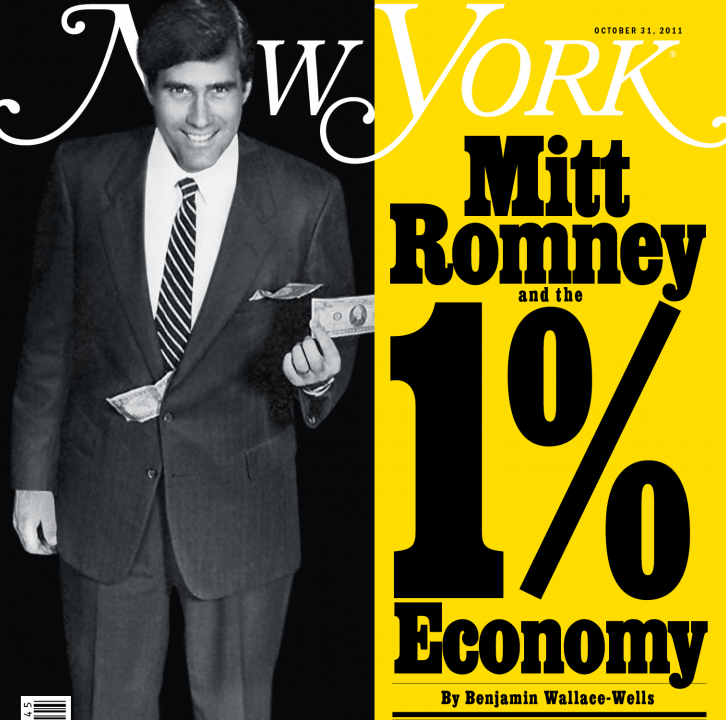
New York Mag has a cover this week that will have the DNC drooling for days. Beyond the cover, the piece by Benjamin Wallace-Wells goes after Romney’s wealth and background in as a Master of the Universe.

The [“corporations are people”] incident, in retrospect, did less to peg Romney as a creature of privilege than it did to reveal something deeper. For Romney, the corporation has long been an object of a certain idealism. It is something he has spent much of his adult life—first as a management-strategy consultant, then as CEO of the private-equity firm Bain Capital—working to perfect, to strip of its inefficiencies until it might function as a perfectly frictionless economic unit.

The piece goes in-depth on Romney’s time at Bain. It may well appeal to Republican base voters and financial elites. But at a time where hundreds of city squares around America are being occupied by people objecting to the powerful control big banks have over our political process, it’s hard to see this as a real asset to Romney.

Beyond the generic assessment as Romney as a titan of industry, the consulting business Romney helped build at Bain is one that resulted in the outsourcing of countless American jobs. Helping businesses grow may be one thing, but when those businesses (like Staples) put thousands of Mom and Pop stores out of business, it isn’t exactly endearing. Peoples’ lives were destroyed to build the economy of Mitt Romney’s dreams and I’m sure plenty of those people will jump at the opportunity to tell their story to the American people as a strike against Romney.

A sophisticated analysis of wealth in America is taking place right now. Mitt Romney and the 1% are not coming out looking good from this analysis and stories which continue to define Romney by his wealth are likely to be politically devastating, at least in the context of the general election.

Occupy Wall Street Still Has Work To Do

Matt Taibbi looks at President Obama’s recent move to trade some requirements for financial disclosure under Sarbanes-Oxley in exchange for business support for his jobs plan. Taibbi:

If the financial crisis proved anything, it’s that Wall Street companies in particular have been serial offenders in the area of dishonest accounting and book-cooking. Sarbanes-Oxley is obviously no panacea, but removing it in exchange for a temporary, election-year job boost is exactly the kind of myopic, absurdly irresponsible shit that got us into this mess in the first place. For Obama to pull this in the middle of these protests is crazy.

Totally agreed. Taibbi goes on and gets at the real point: the work of Occupy Wall Street isn’t done yet:

If anyone thought OWS has already done its job, and Washington has gotten the message already, think again. They’re not going to change until the protesters force them to change, it seems.

There is much work to be done. Change is going to come when protesters force political and financial elites to change. The mere existence of this protest has dramatically shifted the tone of political conversations, but it certainly hasn’t lead to any spontaneous efforts to hold banksters accountable for breaking the economy nor lead Congress to pass job-creating legislation. As a result, it is critically important that the protests continue and the message of the occupiers continue to resonate out into the political world.

Crappy mortgage fraud settlement deal gets worse

There have been new reports of an evolved deal between Iowa Attorney General Tom Miller, the Obama Department of Justice, and the nation’s five largest banks regarding the 50 44 state investigations into robosigning and other fraudulent behavior by the banks. New developments include expanding the release beyond robosigning to cover fraudulent mortgage orgination as well. Professor Adam Levitin has a pretty definitive takedown of the various components of the deal that have been leaked.

One of the pieces of the deal, according to Shahien Nasiripour of the Financial Times, is to include about $2 billion for refinancing borrowers who are current but underwater.

About 150,000 borrowers could benefit from the refinancings, as the vast majority of US home loans are owned by investors and government-controlled mortgage giants Fannie Mae and Freddie Mac. By comparison, nearly 11m US borrowers are underwater, according to CoreLogic, a data provider. The average underwater homeowner owes $258,000 on his mortgage.

So the plan here is to help around 1% of homeowners who are underwater. That’s before we give any consideration to the administration’s horrible track record when it comes to actually implementing programs aimed at helping homeowners to their full capacity. Levitin thinks it will, at best, help around 60,000 homeowners.

And again, what are the states and the federal government giving up in exchange for a couple billion that will barely help any homeowners? Levitin:

now we learn that this settlement is going to include a release of origination fraud claims against the banks in exchange for an additional $2B-$4B. It’s Keystone Cops worse than Keystone Cops. For a while the AGs just looked incompetent in the settlement negotiations. But now it’s gone from incompetence to outright malfeasance. To contemplate a release of origination claims that have never been investigated for an additional $4B is so shocking that I have trouble finding genteel words to say about it. To paraphrase Rep. Elijah Cummings, “Is Tom Miller a chump?” Why on earth does he feel compelled to even discuss such a patently bad deal?] [Emphasis original]

It’s truly hard to capture how bad a deal this is on many levels. It’s a bad deal for homeowners, who aren’t going to get the help they need to keep their homes. It’s a bad deal for the rule of law, where yet again massive corporate criminality is swept under the rug (remember FISA in 2007-2008?). It’s a bad deal for investors, who will likely lose out by not having the knowledge that would come from attorneys general bringing civil suits in every state. It’s just a bad deal.

I’m not convinced that this will actually happen. We’ve heard about imminent deals coming out of the Miller talks for almost as long as they’ve been going on. Thanks to the leadership of AGs who care about their job responsibilities – people like Eric Schneiderman, Beau Biden, Catherine Cortez Masto, Lori Swanson and others – the odds of their being a deal is greatly reduced. But the fact that Miller and the Obama administration keep trying to give away more to get any deal for the banks is sickening. This won’t help anyone, that is, unless you think providing protections to keep bank executives rich and out of jail an important service of government.

Another Bank of America Bailout

Yesterday there were reports that Bank of America Corporation was going to move it’s Merrill Lynch derivatives unit, which is not insured, into Bank of America, which is insured by the FDIC. Early reports suggested that the Federal Reserve supports this move, while the FDIC opposes it. Quoted at The Big Picture, Professor Bill Black explains the process of what is happening and what it means to the public:

1.The bank holding company (BAC) is moving troubled assets held by an entity not insured by the public (Merrill Lynch) to the Bank of America, which is insured by the public
2. The banking rules are designed to prevent that because they are designed to protect the FDIC insurance fund (which the Treasury guarantees)
3. Any marginally competent regulator would say “No, Hell NO!”
4. The Fed, reportedly, is saying “Sure, no worries” by allowing the sale of an affiliate’s troubled assets to B of A
5. This is a really good “natural experiment” that allows us to test whether the Fed is protects the public or the uninsured and systemically dangerous institutions (the bank holding companies (BHCs))
6. We are all shocked, shocked [sarcasm] that Bernanke responded to the experiment by choosing to protect the BHC at the expense of the public.

At his own blog, Black adds, this this transfer would be “transforming (ala Ireland) a private debt into a public debt.”

Yves Smith notes that this development is a clear sign that “Bank of America is in trouble,” something she has been saying for quite some time now.

So this move amounts to a direct transfer from derivatives counterparties of Merrill to the taxpayer, via the FDIC, which would have to make depositors whole after derivatives counterparties grabbed collateral. It’s well nigh impossible to have an orderly wind down in this scenario. You have a derivatives counterparty land grab and an abrupt insolvency. Lehman failed over a weekend after JP Morgan grabbed collateral.

Smith goes on:

But it’s even worse than that. During the savings & loan crisis, the FDIC did not have enough in deposit insurance receipts to pay for the Resolution Trust Corporation wind-down vehicle. It had to get more funding from Congress. This move paves the way for another TARP-style shakedown of taxpayers, this time to save depositors. No Congressman would dare vote against that. This move is Machiavellian, and just plain evil.

It’s another bailout, happening with a gun to the taxpayers’ heads, though albeit somewhat after the fact. More importantly it’s a transfer of wealth from the public to the private with no input from the public.

#OccupyWallStreet’s inspiring donation and supply hub

NY1 has one of the most incredible and inspiring reports on the #OccupyWallStreet movement that I’ve seen. It’s about a large space – a former bank – donated by the United Federation of Teachers – that serves as the movement’s supply store room. It’s stocked with donations of food, medical supplies, clothing, and other essential items which are sustaining the occupation. The donations are coming in from all over the country and all over the world.

The donations coming in often include messages from the people sending them:

Occupiers said almost everything they receive is accompanied by a supportive note.

“Here are some cookies for the demonstrators. I’ll keep sending, as long as you keep protesting,” read Shan. “I’m a 69-year old retired journalist in Ohio who’s very much with you in spirit.”

One occupier told NY1 the notes they get with the supplies are like letters from the “frontline’s of America’s economic crisis.”

I’ve been at #OccupyWallStreet the last few days and had the privilege to see the inside of the storage space. The crew of volunteers who are organizing it and making it function are incredibly motivated by the donations they receive. What’s coming in is likely the lifeline which will allow the occupation to continue to into the cold New York winter.

If you want to send a donation of food, supplies, or anything else that you think the Occupiers will need to be sustained, you can mail donations to the Occupation. According to OccupyWallSt.org, the shipping address is:

The UPS Store
Re: Occupy Wall Street
118A Fulton St. #205
New York, NY 10038
Money orders only please, cannot cash checks yet. Non-perishable goods only. We can accept packages of any size. We’re currently low on food.

NYT editorial on Elizabeth Warren

The New York Times has an editorial in praise of Elizabeth Warren and her candidacy for Senate in Massachusetts. Interestingly (though also accurately) they highlight her ability as an effective messenger on the economy and class issues:

Democrats should not be cowed by conservative taunts that the speech advocated “collectivism,” and use this argument to push back against the Republicans’ refusal to raise the taxes of people who make more than a million dollars a year — sometimes far more. Senate Democratic leaders say they plan to employ poll-tested phrases like “Tea Party economics” and “Tea Party gridlock” in their campaign for a jobs bill and beyond. They would be better off listening to Elizabeth Warren.

I would hope that other Democrats do listen to Warren, though I’m less interested in them appropriating her messaging for its efficacy than adopting the ideology that stands behind the messaging. I don’t want to see a bunch of faux populist rhetoric from Democrats, but I do want to see politicians who are populist. I don’t think many incumbents are populists and I’m not excited by them trying to steal the thunder from those who are actually hearing the complaints of economically disenfranchised people and being responsive to them. That said, one of the supposed virtues of a Senator Warren would be her ability to bring this effective advocacy for the poor, working, and middle classes into an institution which his almost entirely captured by the wealthiest 1%. If the only way to bring conservative Democrats to a better place that gets better results is through cynical analysis of what is polling well, fine. But the existence of political success will be valuable only to the extent that the policies advocated in this messaging are enacted. And now does not seem like the right time to lie to angry voters about what you will or will not do for them.