It is purely extractive

Yves Smith has a must-read post responding to some ridiculous comments by Barclays’ CEO Bob Diamond. Smith highlights the dynamic the banks have set up, namely “Heads We Win, Tails You Lose”:

Diamond’s presentation was yet another reminder of the banking industry’s continued extortion game, namely, that they can take outsized, leveraged risks and when they work out, pay themselves handsome rewards, and when they don’t, dump them on the taxpayer.

But this passage stands out particularly clear:

As we have noted often in the past, the very idea that employees of major banks are entitled to even as much as average wages is a stretch. If the true cost of their operations was priced in, they’d all be out of business. By any standards, they should be paying all the rest of us to be allowed to do so much damage with so little interference.

Andrew Haldane of the Bank of England goes through the math. In a March 2010 paper, he compared the banking industry to the auto industry, in that they both produced pollutants: for cars, exhaust fumes; for bank, systemic risk. While economists were claiming that the losses to the US government on various rescues would be $100 billion (ahem, must have left out Freddie and Fannie in that tally), it ignores the broader costs (unemployment, business failures, reduced government services, particularly at the state and municipal level). His calculation of the world wide costs:

….these losses are multiples of the static costs, lying anywhere between one and
five times annual GDP. Put in money terms, that is an output loss equivalent to between $60 trillion and $200 trillion for the world economy and between £1.8 trillion and £7.4 trillion for the UK. As Nobel-prize winning physicist Richard Feynman observed, to call these numbers “astronomical” would be to do astronomy a disservice: there are only hundreds of billions of stars in the galaxy. “Economical” might be a better description.

It is clear that banks would not have deep enough pockets to foot this bill. Assuming that a crisis occurs every 20 years, the systemic levy needed to recoup these crisis costs would be in excess of $1.5 trillion per year. The total market capitalisation of the largest global banks is currently only around $1.2 trillion. Fully internalising the output costs of financial crises would risk putting banks on the same trajectory as the dinosaurs, with the levy playing the role of the meteorite.

Yves here. So a banking industry that creates global crises is negative value added from a societal standpoint. It is purely extractive.

Smith concludes:

Diamond’s candy-coated defiance shows that three years after the crisis, nothing has changed.

And this is the point. If after a crisis of this magnitude, policy makers in Washington of both parties have decided that there is no need to fundamentally change the role banking plays in the global economy, then the odds of it happening now are basically nil, at least without a fundamental restructuring of politics that includes at least one political party believing in accountability for Wall Street. Most importantly, there must be some cohort in politics and policy making that stands in opposition to a “purely extractive” industry, let alone one that has already wrecked our economy once in recent memory.

First Amendment Baiting

Sarah Palin’s statement on the assassinations in Arizona is days late and more than a few dollars short. Jonathan Singer notes:

It takes Palin nine paragraphs to condemn the violence. By contrast, Palin begins striking a defensive tone in just the fifth paragraph.

What more could we possibly expect than the master of making herself the center of the news cycle? Singer goes on:

The assassination attempt on Gabrielle Giffords that took the lives of six Americans was not about Sarah Palin. The debate that has ensued since has also not been about Palin, except for the extent to which the rhetoric she has used has been used to exemplify the type of over-the-top language Americans would like to see less of in the future. That Palin believes this makes her the center of the story, and moreover that she should release a defensive statement rather than one that calls on Americans to come together only reinforces the sense in many that she does not have what it takes to be a serious leader in this country.

While I certainly believe that Singer is right that Palin has proven her unworthiness as a leader in American politics with this crass, selfish statement, I think he’s missing an important point. Palin has, yet again, shown incredibly savvy. She makes things be about her when they are not about her. She appeals to the cheapest part of American civics, the side that thinks that the First Amendment means not only you can say whatever you want, but that you should be protected from criticism for whatever it is you say.

The statement included this outlandish line:

If you don’t like a person’s vision for the country, you’re free to debate that vision. If you don’t like their ideas, you’re free to propose better ideas. But, especially within hours of a tragedy unfolding, journalists and pundits should not manufacture a blood libel that serves only to incite the very hatred and violence they purport to condemn. That is reprehensible.

Blood libel is a phrase with a very specific meaning. It refers to the anti-Semitic smear that Jews need blood – notably the blood of non-Jewish children – to bake matzos for Passover. Blood libel has historically been used to persecute Jews, including by Hitler in the lead-up to the Holocaust. Palin’s use of blood libel, according to a friend in email, “is an attempt to draw a connection between Hitler and the media. She basically said the media was behaving like Hitler.” Not surprisingly, many Jewish groups are condemning Palin’s use of the term today.

Palin’s statement also included this passage:

Just days before she was shot, Congresswoman Giffords read the First Amendment on the floor of the House. It was a beautiful moment and more than simply “symbolic,” as some claim, to have the Constitution read by our Congress. I am confident she knew that reading our sacred charter of liberty was more than just “symbolic.” But less than a week after Congresswoman Giffords reaffirmed our protected freedoms, another member of Congress announced that he would propose a law that would criminalize speech he found offensive.

I find it hard to believe that prompting a backlash against her use of blood libel isn’t a tidy way for Palin to turn around and say to her supporters, “See, they wanted me to say something about the shooting and now they’re trying to criminalize my speech.”

This isn’t to say groups shouldn’t continue to push back hard on blood libel. But rather, Palin should be criticized not just for using insensitive terms, but for being completely disingenuous. I don’t know if there is a term that is the First Amendment equivalent to race baiting, but Palin is certainly demonstrating a demand for one.

Derived from the far right

The Los Angeles Times:

Most wind up concluding that Loughner suffered from mental problems. But experts said that several oft-repeated phrases and concepts — his fixation on grammar conspiracies, currency and the “second United States Constitution” — seem derived from concepts explored with regularity among elements of the far right.

“What you can see across the board in his writings is the idea that you can’t trust the government — that the government engages in mind control against its citizens,” said Mark Potok of the Southern Poverty Law Center, which has long monitored the radical right.

Loughner’s assertion that he would not “pay debt with a currency that’s not backed by gold and silver” is a running theme among right-wing opponents of the Federal Reserve system.

Disingenuous

George Packer:

But it won’t do to dig up stray comments by Obama, Allen Grayson, or any other Democrat who used metaphors of combat over the past few years, and then try to claim some balance of responsibility in the implied violence of current American politics. (Most of the Obama quotes that appear in the comments were lame attempts to reassure his base that he can get mad and fight back, i.e., signs that he’s practically incapable of personal aggression in politics.) In fact, there is no balance—none whatsoever. Only one side has made the rhetoric of armed revolt against an oppressive tyranny the guiding spirit of its grassroots movement and its midterm campaign. Only one side routinely invokes the Second Amendment as a form of swagger and intimidation, not-so-coyly conflating rights with threats. Only one side’s activists bring guns to democratic political gatherings. Only one side has a popular national TV host who uses his platform to indoctrinate viewers in the conviction that the President is an alien, totalitarian menace to the country. Only one side fills the AM waves with rage and incendiary falsehoods. Only one side has an iconic leader, with a devoted grassroots following, who can’t stop using violent imagery and dividing her countrymen into us and them, real and fake. Any sentient American knows which side that is; to argue otherwise is disingenuous.

Taibbi on Ibanez

I think Matt Taibbi does a good job at getting at the dangers the Ibanez ruling creates, but provides a pretty adequate sense of the scope of what will need to be done to actually make the fraudclosure mess right across the country.

I’m not sure I completely understand the ramifications of it, but certainly it sounds like a great thing on the surface — at the very least, I’m sure the partners of every one of the major Wall Street banks developed 5-6 new hemorrhoids at the news of this decision.

There’s a flip side, of course, which is that decisions like this, and ones that invalidate the MERS transfers — they may forestall unjust foreclosures and keep people in homes, but they won’t actually do much to fix the situation. Preventing bad foreclosures is great, but I’m pretty sure they need to come up with some sort of legislative solution to a) properly compensate the investors in the MBS who are usually the true owners of the mortgage b) negotiate new payment schedules so that homeowners who win these applications don’t feel like squatters but legitimate owners c) preserves as much as possible the credit scores of the homeowners in question, and d) create a modern registry system that does make sense, that both compensates the state for taxes and makes sales of mortgages efficient. I don’t think they can do this through the courts; we’re going to need a federal law that creates a logical procedure for dealing with the bad mortgages from the bubble period, an amnesty or a federal review or something. The problem is, of course, is that any move to legally change the status of these mortgages would affect the value of all these mortgage-backed instruments still floating around, which would leave these banks more or less instantly bankrupt, which would set the stage for another round of bailouts. If this decision means the banks have to take a big loss, they’ll find a way somehow to put that bite back onto the taxpayer. As I saw a commenter on Zero Hedge (with the apt handle what_a_mess_man) write, “cue another back-door, taxpayer-funded bank bailout in 3…2…1!”

I really don’t think there’s any why for there to be a judicial solution that is similar across all fifty states. Or rather, while each state is obviously entitled to follow its own real estate law, I don’t know that waiting around for 50 individual solutions is realistic. Fraudclosure is a systemic risk. There needs to be a response targeting the entire system, which necessitates a federal one.

The starting point for federal conversations about how you solve this needs to include the following premises: (1) property rights must be preserved in America; (2) the big banks are already insolvent; (3) people that have repeatedly fracked the economy do not deserve compensation for doing so, let alone the opportunity and backing of the federal government to do it again. A solution would likely involve breaking up all of the Too Big To Fail banks, providing a bailout directly to their RMBS investors, and cramdown for all underwater mortgages in exchange for a proper sorting out of ownership to these notes, most likely as Taibbi says to the owners of residential mortgage backed securities.

Obviously this is a very rough approximation of how to solve some of the big, top-line issues in the fraudclosure time bomb. But at a certain point, until some of the biggest issues about how to deal with TBTF banks, MBS investors, and underwater homeowners are addressed, the other questions can’t be answered adequately. We have to know what we want the economy to look like at the end of this thing to make the right steps in that direction.

A Sneaky Teenager

What Jane said:

I won’t speculate on the role Palin played in motivating the actions of Jared Loughner — nobody can know that for sure, probably not even him. But the irresponsible nature of Palin’s actions speak for themselves, and don’t need the affirmation of outside events to qualify as alarming and foolhardy. You want to act recklessly? Fine, drive a race car. Put out oil fires. Climb the Himalayas. You do not have the maturity or the judgment to be President of the United States.

Further, Palin’s retreat into self-pity and victimization in the wake of the shooting demonstrates that she is utterly devoid of self-reflection, completely unable to acknowledge her failure to gauge the dangers inherent in the situation at the time, or learn from her mistakes. She acts like a sneaky teenager. She lies. She pushes others out there to take the hits for her, incapable of even acknowledging her role as a political leader who consciously exerts influence over how her followers should interpret and respond to events.

Polarization

Matt Yglesias seems a bit surprised to find that polarization doesn’t always break on partisan lines but on ideological ones, looking at the example of Martin Luther King Jr. and George Wallace, who were both Democrats. But polarization isn’t limited to Red Team/Blue Team parameters, as set out by the DC press corps. King was a liberal, Wallace was a conservative. Moreover, on the issues of segregation and civil rights, King was the leading advocate for change and Wallace a leading obstacle for the change King sought. Wallace and his supporters – all conservatives, but of both parties – used violence, intimidation, and assassination as tools to fight civil rights. King preach non-violence and civil disobedience as a means to challenging segregation in America.

I do think Yglesias gets that ideology is a larger driver of polarization than partisan identification. But it cuts the other way as well. Just because Loughner may not have been citing his desire to vote for Sarah Palin for President doesn’t mean he wasn’t a conservative. And at heart, the GOP has played the Tea Party as a conservative movement, not a Republican one. If you doubt that, just ask the Tea Party, which goes to great lengths to say they aren’t a Republican front. The driving factor in the Republican base, the thing that their leaders speak to, is conservativism, not Republicanism. And so when events like this weekend’s assassinations happen, it is not relevant whether the shooter espouses Team R for Republican leaders to be culpable, only conservative ideas. While details are still emerging, it does seem like Loughner comes from the fringe areas of the conservative movement. The rhetoric on trial should rightly be viewed as conservative, not Republican.

The Tree of Liberty

Alex Pareene has a good piece over at Salon. Pareene writes:

The Tea Parties are based around the rhetoric of the American Revolution, which was a violent insurrection. It makes a sad sort of sense that a bunch of comfortable white reactionaries would dress up their childish tantrums with such grandiose language, because “desperately protecting your privilege in the face of what appears to be the demise of the empire” sounds much less inspiring than “defeating tyranny.”

As the Republican Party has become more homogeneous, more regional, and more reactionary, they have tended to make up for their growing demographic shortcomings by making sure their supporters are more motivated and energized — and the most effective way to energize them has been to make sure they’re constantly enraged.

When the GOP didn’t have the votes to stop healthcare reform from passing, their strategy — and it almost worked — was to scare Democratic elected officials. That was the point of telling everyone to shout themselves hoarse at the town halls: to terrify House members. Convince them that their constituents were incensed. If some LaRouchites or other unclassifiable political entities got into the mix, fine — more voices for the choir of rage. What was formerly a sort of uneasy tolerance of the extremists inched closer to open acceptance. Roger Ailes allows Glenn Beck to run amok spreading classic Bircher paranoia. Matt Drudge links to conspiracy-mad broadcaster Alex Jones. Everyone in the party had to pretend to be cool with idiot extremist Oath Keeper Sharron Angle, because the craziness the right-wing whipped up led their primary voters to select her over the safe party hack who would’ve handily defeated Harry Reid. There are connections — both direct and spiritual — between the far-right Patriot movements that flourished in the ’90s and some of the more out there elements of the Tea Parties.

When everyone’s hoisting guns and shouting “tyranny” and playing at being a revolutionary, there will be a couple people who don’t see the wink.

I think the simple reality is this: if Republicans had an ideology and a substantive, positive policy agenda that was greater than speeding up the transfer of wealth from working Americans to the richest 1% of Americans, they would run on that. But they don’t. So instead they stomp their feet about incremental policy reforms to things like health care and the finance industry that, at most, at a patina of liberalism to the status quo without substantially changing things one iota. They talk about these small changes as socialism, as communism, and as tyranny, exhorting their audiences to be their own little Patrick Henrys.

Again, were the Republican Party not so devoid of palatable ideas, they would not have to use violent and extreme rhetoric to drum up enthusiasm for the public. But they’re afraid to talk honestly about their agenda of class warfare on behalf of Wall Street. Surely this reality would be hilariously embarrassing for Republicans, if they had any shame. We know they don’t, again as evidenced by their absurdly extreme opposition to a health care bill effectively cloned from that proposed by a leading 2008 Republican presidential candidate. In the end, there shouldn’t merely be calls for Republican leaders to cease using violent rhetoric in their opposition to Democrats, but instead that call for cessation should be accompanied by a call for for Republicans to finally talk honestly about the things they do support and why they support them, without the trappings of Revolutionary War rhetoric and regalia.

Assassination in Arizona

I haven’t posted earlier for two reasons – first, there’s still a lot of information and insight coming out of the investigation in Arizona. Second, the pace of rapid fire punditry was somewhat overwhelming. At a certain point, while people are still in surgery, I don’t really care to be arguing with conservatives on Twitter about the level of their leaders’ culpability for their persistently violent rhetoric in opposition to the Obama administration and Democratic policy pursuits.

The press and public figures may not be willing to admit it, but violence has been a hallmark of American politics since our country’s inception. While over the course of our history violence has been perpetrated to further political means by both sides of the political spectrum, over the last hundred years (at least) conservatives have been far more likely to use violence as a means of political expression. From the Oklahoma City bombing to the murder and lynching of countless civil rights activists (or random African-Americans) during the Civil Rights era, the American right has a real, terrifying history of using violence. It is this history that makes the comments by Republican figureheads like Sarah Palin, Glenn Beck, Sharron Angle and Michele Bachmann so dangerous. The rhetoric exists in a historical context that is marred by violence.

In many regards, the violent rhetoric that we see realized in Tucson started with President Obama’s inauguration and the legislative process of reforming health care. The August 2009 recess was defined by the frequent disruptions of town hall discussions by Tea Party radicals. Many town halls were canceled because of threats made against legislators. The threats weren’t solely directed at people making policy – many organizations that supported the President and reform, including my own labor union – were inundated with threats of violence from conservatives.  One Glenn Beck viewer became so inspired by Beck’s smears of the non-profit Tides Foundation that he took up arms and drove to Oakland to try to kill them all, only to end up in a fire fight with the police.

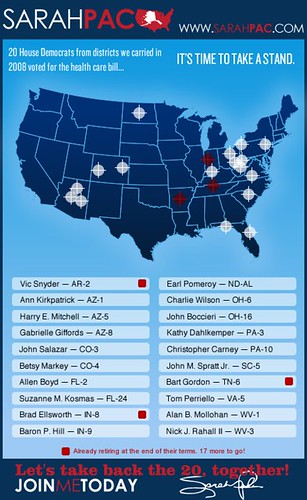
A lot has been made that Rep. Gifford was one of the Democrats literally put in the crosshairs by Sarah Palin’s PAC. Gifford herself thought that it was provocative and dangerous, telling MSNBC “they’ve gotta realize there are consequences to that action.” Of course, Palin and her staff immediately tried to scrub references to the target map after the shooting. One spokesperson even went so far as to suggest the scope crosshairs were not even targets.

In fact, she said that the “target list” was not intended to allude to guns.

“We never ever, ever intended it to be gun sights,” she said.

“It’s surveyor’s symbols,” the interviewer Tammy Bruce suggested. Bruce, a Palin supporter, describes herself as “a gay, pro-choice, gun owning, pro-death penalty, Tea Party Independent Conservative. ” Her show is promoted as a “chick with a gun and a microphone.”

Mansour agreed. She said that the graphic was contracted out to a professional. They approved it quickly without thinking about it. “We never imagined, it never occurred to us that anybody would consider it violent,” she said. Rather, she said, that it was simply “crosshairs that you would see on a map.”

There is “nothing irresponsible about our graphic,” she said.

I am hard pressed to think of a single statement in American politics that is more outrageous and dishonest than this. Even Sarah Palin thinks the target symbols were target symbols, saying in a tweet:

@SaraPalinUSA Remember moths ago “bullseye” icon used 2 target the 20 Obamacare-lovin’ incumbent seats? We won 18 out of 20 (90% success rate;T’aint bad)

As I said, I can’t think of a more dishonest, outrageous statement in recent political history than Palin’s spokesperson saying these were surveyor marks and not bullseye targets. If they were in fact a surveyor or mapping symbol, then Palin would not refer them to as “bullseye icon[s]” and her staff would not be scrubbing the internet of that image and those tweets. Beyond this, Dave Weigel points out that Palin repeatedly doubled down on the target map throughout the 2010 campaign. Any suggestion to the contrary is completely ludicrous.

The fact that we are even in a position where the leading public figure of one political party has to deny that her words and her imagery actually encouraged violence is a testament to how outlandish Palin’s rhetoric was to begin with. But as bad as she has been, she is hardly the sole perpetrator of violent rhetoric on the right. It is disturbingly ubiquitous from leaders on the right, especially as the Tea Party has risen as a power base within the GOP. Something is deeply wrong when the language of violence is used to create enthusiasm for one political party, due to unhappiness with the previous results at the ballot box. When words like traitor, socialist, fascist, and communist are tossed around as needs for Republicans to “take our country back” and use “Second Amendment remedies” to achieve their goals, it is not shocking that some of their followers eventually do take up arms.

Yesterday Paul Krugman blogged:

You know that Republicans will yell about the evils of partisanship whenever anyone tries to make a connection between the rhetoric of Beck, Limbaugh, etc. and the violence I fear we’re going to see in the months and years ahead. But violent acts are what happen when you create a climate of hate. And it’s long past time for the GOP’s leaders to take a stand against the hate-mongers.

Pima County Sheriff Clarence W. Dupnik gave a soul-searching press conference yesterday (quotes from an emailed transcript & this story):

“When you look at unbalanced people, how they respond to the vitriol that comes out of certain mouths about tearing down the government. The anger, the hatred, the bigotry that goes on in this country is getting to be outrageous. And, unfortunately, Arizona I think has become sort of the Capital. We have become the Mecca for prejudice and bigotry.””It’s not unusual for all public officials to get threats constantly, myself included. And that’s the sad thing of what’s going on in America. Pretty soon, we’re not going to be able to find reasonable, decent people who are willing to subject themselves to serve in public office.”

“It’s time to do a little soul searching about the rhetoric we hear on the radio, how are children are being raised,” the sheriff said.

Republicans are calling for Sheriff Dupnik to resign over these comments, citing fears that they will prompt violence against the right. This would be remarkable if it weren’t entirely within the playbook of the modern Republican Party – attack your opponent where you are most weak.

There is still a tremendous amount of information that will come out about the motives of John Loughner. There is no scenario wherein someone takes a gun into a crowded political event and starts shooting that doesn’t involve them being mentally sick. But putting a gun to the head of a congresswoman point-black and pulling the trigger is an inherently political act. Regardless of what the final answer, if one emerges, about Loughner’s motivations, there is simply no reason for leading Republicans and media figures not to follow Sheriff Dupnik’s advice and do their own soul searching and tone down their rhetoric.

Boehner’s Social Safety Net

Matt Taibbi on Olbermann:

But in Boehner’s case, what’s so funny about it [the people who deserve a social safety net], is the people who can’t compete, I think, in his eyes are, if you go by his TARP vote, it’s JP Morgan Chase and Goldman Sachs and Bank of America. I mean, those are the people he’s talking about when he talks about a social safety net.

Taibbi has a full profile of Boehner in Rolling Stone.