Newt Gingrich earned $1.6m+ from Freddie Mac

Originally posted at AMERICAblog Elections: The Right’s Field

Rut-roh. Bloomberg is reporting that Newt Gingrich “made between $1.6 million and $1.8 million in consulting fees from two contracts with mortgage company Freddie Mac.” Gingrich worked with Freddie Mac from 1999 to 2002, as the housing bubble was beginning to rapidly expand.

What’s remarkable about this is that Gingrich viewed Freddie Mac as a vehicle for the Republican Party to gain support from the Hispanic community.

“I spent about three hours with him talking about the substance of the issues and the politics of the issues, and he really got it,” said Delk, adding that the two discussed “what the benefits are to communities, what the benefits could be for Republicans and particularly their relationship with Hispanics.”

This pretty strongly undercuts some of the political arguments waged by pro-bank Republicans who seek to blame the GSEs for inflating the housing bubble. Gingrich was pushing them to do it to help Republicans! It makes Gingrich’s call for Barney Frank to be jailed – instead of banksters – for the financial collapse even more insane.

And while Gingrich has claimed that he advised Freddie Mac that they were creating a housing bubble, Bloomberg reports, “None of the former Freddie Mac officials who spoke on condition of anonymity said Gingrich raised the issue of the housing bubble or was critical of Freddie Mac’s business model.”

Oh Newt, I have a feeling that it’s going to be fun having you near the top of the polls.

Rick Perry’s real disaster

In last night’s debate, Rick Perry had a big gaffe while trying to name three federal agencies that he would flat-out cut if elected President. He was quick to name Education and Commerce, but couldn’t remember the third one over the course of over 50 seconds. The EPA was suggested to him by his colleagues on stage, but he said, no, that’s not it.

Not shockingly, the immediate reaction and early reports was that this gaffe would likely be fatal for Perry. He couldn’t remember three things despite a minute to get the third one and help from his colleagues on stage (he later said it was Energy). Yes, this was undoubtedly a failure in execution of the highest order.

But as Matt Stoller was quick to point out on Twitter, the thing that was crazy about this debate moment wasn’t that Perry couldn’t remember three things, it’s that he was proposing destroying the Commerce, Education, and Energy Departments and no one was challenging him on what this would actually mean for the country or the people who worked there.

[View the story “@matthewstoller” on Storify]

Stoller’s right that these serious questions are being completely glossed over by the reaction to the gaffe. How Perry thinks we would fund the maintenance and security of our nuclear arsenal is a big deal. Cutting funding for children with special needs would be a huge tax on parents. These are big questions.

It’s common that those of us in the liberal blogosphere remark on the vapidity of the DC press corps. But looking at Twitter, many Democratic operatives and liberal bloggers were just as fixated on the gaffe and not the insanity of Perry’s ideas. I’m just as guilty of that as anyone. And this is a real problem, not just with the press, but with American political culture.

These are serious times and the level of debate should be high and serious. Parts of the CNBC debate, especially on the exposure US banks have to European debt and rapidly increasing risk, were both important and enlightening. It turns out Jon Huntsman is strongly against the continued existence of Too Big To Fail institutions. Unfortunately many of his opponents think that we can ignore Europe and not expect to be affected by what is happening in the Eurozone. The degree of dangerous ignorance emanating from the stage was so thick that even the CNBC moderators pushed back on it, to an extent. The Republican candidates’ responses to these immediate questions are much more relevant that what agencies they pledge to eliminate or what they would do if Obamacare was repealed. The economic crisis facing Europe will almost certainly be playing itself out a year from now, in some form or another, and it will almost certainly be an immediate, major US public policy issue long before then (actually, it is now). The insanity of most of the panels’ answers to questions about the ongoing financial crisis is far more important and more dangerous than the inability of one demagogue to effectively utter his demagoguery.

Third Way advising Tea Party to support Super Committee

The conservative Democratic think tank Third Way has written a policy memo as to why the Tea Party should support the Super Committee making big budget cuts, as opposed to the sequestration that would happen if the Super Committee can’t come to agreement . Some examples of Third Way’s reasoning to support this version of austerity and not the automatic cuts include:

  • 12,000 Criminals Evade Incarceration
  • Possible Prison Furloughs
  • A More Porous Southern Border
  • Gun Purchase Delays

Basically Third Way is saying that unless the Super Committee gets to make big cuts to the federal budget, the automatic big cuts will make America filled with dangerous brown people and Tea Partiers will have a harder time buying guns to defend themselves.

Remind me again why any Democrat would listen to Third Way’s advice?

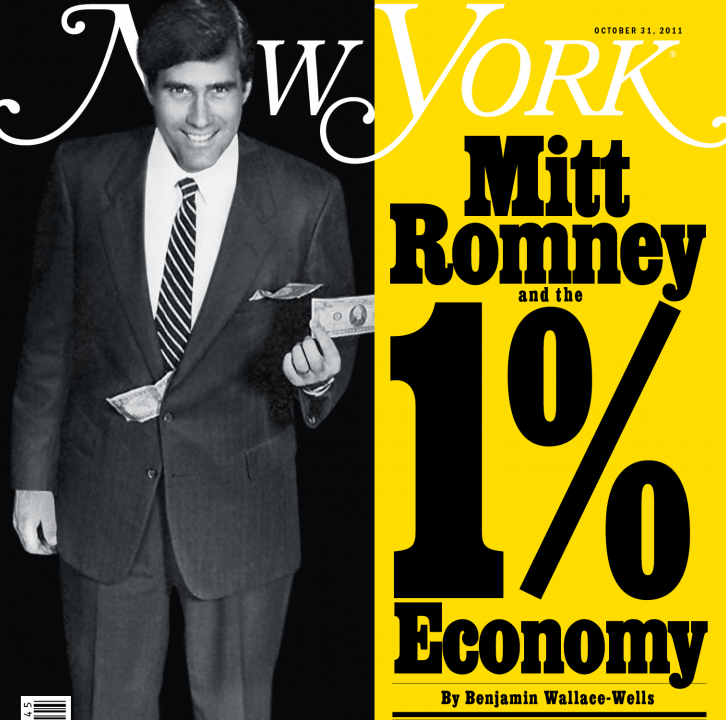
Mitt Romney and the 1%

New York Mag has a cover this week that will have the DNC drooling for days. Beyond the cover, the piece by Benjamin Wallace-Wells goes after Romney’s wealth and background in as a Master of the Universe.

The [“corporations are people”] incident, in retrospect, did less to peg Romney as a creature of privilege than it did to reveal something deeper. For Romney, the corporation has long been an object of a certain idealism. It is something he has spent much of his adult life—first as a management-strategy consultant, then as CEO of the private-equity firm Bain Capital—working to perfect, to strip of its inefficiencies until it might function as a perfectly frictionless economic unit.

The piece goes in-depth on Romney’s time at Bain. It may well appeal to Republican base voters and financial elites. But at a time where hundreds of city squares around America are being occupied by people objecting to the powerful control big banks have over our political process, it’s hard to see this as a real asset to Romney.

Beyond the generic assessment as Romney as a titan of industry, the consulting business Romney helped build at Bain is one that resulted in the outsourcing of countless American jobs. Helping businesses grow may be one thing, but when those businesses (like Staples) put thousands of Mom and Pop stores out of business, it isn’t exactly endearing. Peoples’ lives were destroyed to build the economy of Mitt Romney’s dreams and I’m sure plenty of those people will jump at the opportunity to tell their story to the American people as a strike against Romney.

A sophisticated analysis of wealth in America is taking place right now. Mitt Romney and the 1% are not coming out looking good from this analysis and stories which continue to define Romney by his wealth are likely to be politically devastating, at least in the context of the general election.

Chris Christie & the confused Republican Party

Originally posted at AMERICAblog Elections: The Right’s Field

If there’s one dynamic that has yet to be resolved within the Republican presidential primary, it’s the tension between the demands of the radically conservative Tea Party base and the 51% of Republicans who do not identify as or support the goals of the Tea Party. Presumably a large part of the Republican establishment and media talking heads fall into the 51% that don’t swing the Tea Party’s way. As a result, you get repeated expressions of dissatisfaction from both the far right and the slightly further right for candidates which better fit their ideological vision. Rick Perry was pitched as a savior, yet once he entered he was exposed both as more of a bumbling fool than any non-Texan would have thought and is being damned from the right for his completely sober and responsible notion that if we can stop teenage girls from contracting a virus which causes cancer, we should do it.

Over the last week and a half we’ve seen both Mike Huckabee and Chris Christie discuss entering the primary to fill this void. Most Republicans already know what they’d get with Huckabee – an extremely conservative member of the religious right who also displays some economic populist notes while being slightly to the left of Attila the Hun (and therefore unacceptable) in his immigration stance.

Christie is a different story. While he’s burnished his Republican credentials by aggressively seeking to bust public worker unions in New Jersey, he holds a number of other positions which are anathema to the Tea Party base. Specifically, all the Republicans clamoring for Christie to enter the race fail to recognize that he will have a problem for believing that climate change is real and humans contribute to it. And I shudder to think how the mouth breathers will react to seeing him rip apart the anti-Muslim bigots who oppose Chrisite’s appointment of Sohail Mohammed to the NJ state bench:

https://www.youtube.com/v/y83z552NJaw?version=3&hl=en_US&rel=0

As a progressive, I worry about Christie entering the race. He’s smart, affable and a powerful communicator. But while he may not pass muster with the Tea Party crowd, he’s a radically conservative politician who would seek to destroy workers’ rights and make business unaccountable to the public.

At some point, I wonder if the Republican primary will hinge around electability. But until then, it will focus on the candidate who comes closest to complete ideological purity with the Tea Party base. Christie may get in. Huckabee may get in. But I doubt either will be sufficiently crazy to please the base and win the nomination.

Bachmann vulnerability over HPV mistakes

Michele Bachmann is starting to get some real blowback over her missteps around the HPV attack on Rick Perry. The New York Times reports:

In the pugilism of this week’s Republican presidential debate, Representative Michele Bachmann seemed to have landed a clean blow against Gov. Rick Perry over an order he issued requiring Texas schoolgirls to be vaccinated against a sexually transmitted virus.

But then in follow-up interviews, Mrs. Bachmann suggested the vaccine was linked to “mental retardation.”

As experts quickly pointed out, there is no evidence whatsoever linking the vaccine to mental retardation — and Mrs. Bachmann ended up shifting the focus off Mr. Perry and on to her long-running penchant for exaggeration.

It is a pattern her current and former aides know well — her tendency to let her passion for an issue overwhelm a sober look at the facts, resulting in indefensible remarks that, in a presidential primary race, are raising questions about her judgment and maturity.

It’s important to distinguish how a candidate plays with non-Republican primary voters and how they play with Republican primary voters. Clearly the DC media is swarming over Bachmann’s mistakes and the HPV screw-up certainly doesn’t make liberals like myself want her to do well. But her attacks in the debate were strong, direct, and put Rick Perry on the defensive. He looked off-balance and unable to adequately explain himself, beyond making clear that it costs more than $5,000 to buy him off. As a result, I have to wait and see how this affects her support among actual Republican primary voters to see how much it hurts her.

…Adding, obviously this stuff hurts Bachmann in the general election, but I think we are miles away from having to consider Bachmann in the context of general election outcomes.

A Republican insider takes on both parties

Via John Aravosis, this piece at Truthout by Mike Lofgren, a thirty year veteran Republican staffer, is an interesting read. Lofgren claims he resigned recently after watching the GOP get taken over by lunatics (his word) like Michele Bachmann, Allen West, Patrick McHenry and Steve King.

This passage stands out:

A couple of years ago, a Republican committee staff director told me candidly (and proudly) what the method was to all this obstruction and disruption. Should Republicans succeed in obstructing the Senate from doing its job, it would further lower Congress’s generic favorability rating among the American people. By sabotaging the reputation of an institution of government, the party that is programmatically against government would come out the relative winner.

Lofgren astutely notes the media’s complicity in this sabotage, through the devolution of journalism from a noble profession practiced by talented individuals to a medium defined by false equivalencies and “he said, she said” reporting.

While Lofgren’s critique of his own party is devastating, his analysis of the failings of the modern Democratic Party is also insightful.

What do the Democrats offer these people? Essentially nothing. Democratic Leadership Council-style “centrist” Democrats were among the biggest promoters of disastrous trade deals in the 1990s that outsourced jobs abroad: NAFTA, World Trade Organization, permanent most-favored-nation status for China. At the same time, the identity politics/lifestyle wing of the Democratic Party was seen as a too illegal immigrant-friendly by downscaled and outsourced whites.

While Democrats temporized, or even dismissed the fears of the white working class as racist or nativist, Republicans went to work. To be sure, the business wing of the Republican Party consists of the most energetic outsourcers, wage cutters and hirers of sub-minimum wage immigrant labor to be found anywhere on the globe. But the faux-populist wing of the party, knowing the mental compartmentalization that occurs in most low-information voters, played on the fears of that same white working class to focus their anger on scapegoats that do no damage to corporations’ bottom lines: instead of raising the minimum wage, let’s build a wall on the Southern border (then hire a defense contractor to incompetently manage it). Instead of predatory bankers, it’s evil Muslims. Or evil gays. Or evil abortionists.

How do they manage to do this? Because Democrats ceded the field. Above all, they do not understand language. Their initiatives are posed in impenetrable policy-speak: the Patient Protection and Affordable Care Act. The what? – can anyone even remember it? No wonder the pejorative “Obamacare” won out. Contrast that with the Republicans’ Patriot Act. You’re a patriot, aren’t you? Does anyone at the GED level have a clue what a Stimulus Bill is supposed to be? Why didn’t the White House call it the Jobs Bill and keep pounding on that theme?

You know that Social Security and Medicare are in jeopardy when even Democrats refer to them as entitlements. “Entitlement” has a negative sound in colloquial English: somebody who is “entitled” selfishly claims something he doesn’t really deserve. Why not call them “earned benefits,” which is what they are because we all contribute payroll taxes to fund them? That would never occur to the Democrats. Republicans don’t make that mistake; they are relentlessly on message: it is never the “estate tax,” it is the “death tax.

Lofgren actually mistakes inept messaging with desired political outcomes, while simultaneously missing the real point of the DLC-made Democratic Party’s free trade policies. Give voters too much passion from the government as a source of job creation and health care, and they’re bound to want more. But that’s not what the corporatists in the right of the Democratic Party want, so they don’t push for it. Obama and many conservative Democrats are pushing for cuts to the Big Three social support programs. They don’t want there to be an estate tax, because they don ‘t want their rich donors to be taxed. So when Lofgren writes, “The GOP cares solely and exclusively about its rich contributors,” it’s also the case that the same could be said for many, many conservative Democrats.

Lofgren’s piece shows him as someone who is outraged by what is happening in an America where one of two political parties is hell-bent on destroying government. But his analysis of the other party is centered around political cravenness, giving no real attention to the rightward shift of controlling Democratic ideology. In the end the problems don’t necessarily arise from one party dashing to the right, but the other moving along with it. In that sense, no choice is preserved for voters and thus the people who make the move to shift to the frame of acceptable debate are the ones who win out over time.

Lofgren spent 28 years working on at the House and Senate Budget Committees. I’m sure he has seen an evolution in how the Democratic Party operated and how the increased influence of first the DLC and then Third Way shifted the Democrats to the right, while a similar shift was ongoing in his party. It would be interesting to see him write about that narrative, now that he’s established himself as a smart, credible critic of government and politics in the 21st century.

Ezra’s World

What world does Ezra Klein live in?

To govern responsibly, Democrats cannot simply raise taxes on the rich and call it a day. That’s a world in which Republicans continuously force crises, refuse taxes, and extract deeper and deeper cuts. Already, Senate Minority Leader Mitch McConnell (R-Ky.) has called the GOP’s debt-ceiling brinksmanship “a new template” and promised that “in the future, any president, this one or another one, when they request us to raise the debt ceiling, it will not be clean anymore.”

Um, Ezra, that’s the world we already live in. Republicans continually force crises, refuse to raise taxes and extract deep and deeper cuts. So given that Republicans are already doing what Ezra fears they will do if Democrats suddenly and miraculously started believing in and realizing real tax hikes for the rich, why wouldn’t Democrats do this? Again, not for the reasons that Ezra says, because they are already realized. No, the real reason would be that Democratic elites, including most of the Senate, much of the House and the administration just don’t believe that the rich should have their taxes raised, for the rich are job creators and while a small jet tax here or a slight increase for oil companies there is okay, going back to Reagan’s 1986 top bracket rate of 50% would be class warfare. And today’s Democrats just don’t do class warfare against the rich – they’re too busy doing it against the poor, working, and middle classes of America.

The perils of pivoting to jobs

Originally posted at AMERICAblog

Though it sounded like spin to keep liberals quiet at the time, there was a lot of talk prior to this deficit deal that once it was passed, the administration and Democrats on the Hill would shift towards job creation efforts and a jobs narrative.

To the extent that Politico’s Mike Allen is a leading indicator that political insiders use to preview political work, it seems that the pivot to jobs is actually happening. Today’s Politico Playbook has an in-depth look at how the administration and congressional Democrats plan to switch the conversation to job creation and getting the economy back on track.

Before anything else, I think it’s important to say that I absolutely support the pursuit of job creation legislation. Lots of liberals who write online and lots of left-leaning institutions – from labor to MoveOn and other campaigning organizations – have been pleading for months for there to be a focus on job creation. A stronger economy built through the creation of good-quality, well-paying jobs is the cure for what ails America. It will reduce the suffering working and middle class Americans are going through now. It will keep more people in their homes. And a stronger economy driven by higher employment would dramatically increase tax receipts, reduce the deficit and at least from a purely economic standpoint, reduce the likelihood for social programs to be on the chopping block.

I just worry that there’s either (a) a lack of recognition of what just happened in the deficit debate and how the “deal” will impact all other legislation that requires money to work, and (b) a continued assumption that Republicans will be reasonable and good faith negotiators. To wit:

A Senate Democratic official tells Playbook: “There is nothing stimulative or jobs-based in this final deal that got struck. That’s unfortunate, but it also gives us an opening in September that we can say, ‘We’ve met you halfway and passed a huge, historic debt-reduction measure. Now it’s time to do something for jobs. The administration has been saying for weeks, ‘Once we get off this debt-ceiling thing, we’ll be able to get back to jobs.’ In the last 24 to 48 hours, one of their selling points of this deal has been that it resolves this thing so we can get back to jobs.

Dems, hoping to actually pass something, plan to emphasize tax cuts, and spending measures that have been embraced by the U.S. Chamber of Commerce, giving them cross-party appeal. [Emphasis added]

Four of the seven measures Allen previews are tax cuts. If I had to put money down, I’d predict that if any jobs bill moves forward, it will consist of more than 50% tax cuts, and probably more likely, a four or five to one ratio of tax cuts to stimulative spending measures.

Two thoughts here.

First, the language from Democrats sounds disturbingly like the mindset of December 2010, where after the deal extending the Bush tax cuts it was taken on faith that the GOP would behave like grownups on the debt ceiling and not play games.   Regardless of why that analysis coming from the White House was wrong, it was devastatingly wrong.  Even if you never paid attention to how the modern Republican Party behaves prior to the last eight months, there’s zero reason any person who has followed recent events should think that the Republican Party is interested in anything close to responsible governance.

There will be no GOP concessions to reciprocate for what Democrats have given during the deficit deal negotiations. Expectations to the contrary should be rejected on their face, and anyone who posits them is at best stupid and at worst lying.

Second, the fight we just had was not about the debt ceiling. It was about the deficit, and everyone (well, other than the top 2%) is going to have to swallow some pretty bitter pills as a result.   I simply don’t know how the GOP is going to let through any new government spending to create jobs without at least equal cuts elsewhere.  Conservatives – and clearly we must count President Obama as one of them – have created a zero-sum game when it comes to the federal budget. The sole caveat here is that because conservatives don’t actually care about the deficit, I can easily see a scenario where tax cuts will be allowed without comparable spending cuts elsewhere. But that still puts Democrats in a position of adopting failed Republican policy solutions to try to fix the economy, while simultaneously stipulating that liberal ideas are not a viable solution to our weak economy and our high unemployment.

To put it differently, by operating in such a framework, the Democratic Party is actively destroying liberalism as a valid set of ideas to be considered by the American public.

I would love to be wrong, but right now I’m not optimistic about how the next few months will play out – whether it’s the supposed pivot to job creation, the budget fight, or the highway bill reauthorization (which includes the gas tax), there are ample opportunities for conservatives to grind things to a halt with deficit hysteria.

The GOP just learned that President Obama is an enthusiastic partner in this hysteria, and the Democrats on the Hill are equally willing to go along with “deficit panic.” This doesn’t mean that Democrats should not try to pass a stimulative jobs bill – given the anti-stimulative effect of the deficit deal it’s needed now more than ever. But the chances of a good bill, that doesn’t come at the continued cost of reducing other important social support programs, seem low, and will only be made lower if Democrats continue to expect conservatives to come to the table as good faith partners in job creation.
The Ideological Continuum

Over at ThinkProgress, Brad Johnson has a good post about the deficit reduction debate that’s been tied to the debt ceiling. He puts the political positions of progressives, President Obama, and the Tea Party side by side to draw out a continuum of recommended actions (or non-action). Johnson writes, “As of this moment, the president’s negotiating stance is a lot closer to the radical, destructive goals of the far right than to the climate hawks and progressives.”

Not included in Johnson’s analysis are the positions of the mainstream Democratic Party (arguably represented by Harry Reid) and the mainstream Republican Party (arguably represented by John Boehner and Mitch McConnell). I think the omission here is interesting in part because it would show the near-total capture of the mainstream Democratic Party by the President’s conservativism, which places them in the same place as most of the Republican Party. Yes it’s important that in Johnson’s chart, Obama is closer to the Tea Party than Progressives. But it’s probably more important that he’s where the non-Tea Party GOP is and he’s brought the non-progressive Democratic Party along with him. This is an incredibly important  dynamic as it signifies the functional end of the Democratic Party as a vehicle for liberalism (let alone populism or progressivism).