Yet again, Chris Hedges really gets what’s happening in the world and what #OccupyWallStreet is about.
Category: Economy
A Victory for #OccupyWallStreet
Late last night, New York Mayor Mike Bloomberg and Brookfield Properties, the owners of Zuccotti Park, backed down from their attempt to evict #OccupyWallStreet. MoveOn shot a great video of the protesters getting the news and their reaction. #OccupyWallStreet put a statement out following the victory:
“We are winning and Wall Street is afraid,” said Kira Moyer-Sims, a protester from Portland, Oregon. “This movement is gaining momentum and is too big to fail.”
“Brookfield Properties is the 1%. They have invested $24 billion in mortgage-backed securities, so as millions face foreclosure and eviction due to predatory lending and the burst of the housing bubble that Wall Street created, its not surprising they threatened to evict Occupy Wall Street,” said Patrick Burner, an organizer with Occupy Wall Street from the Bed-Stuy neighborhood of Brooklyn. “But Brookfield and Bloomberg have backed down and our movement is only growing as the 99% take to the streets world wide to call for economic justice.”
This is a powerful movement and it is capable of bending huge corporations and powerful politicians to their will. This is just the beginning.
NY Mayor Bloomberg moves to evict #OccupyWallStreet
Mike Bloomberg, New York City’s billionaire mayor, is taking the first strong step towards evicting #OccupyWallStreet from Zuccotti Plaza, where the occupation has been taking place. Zuccotti Plaza used to be a public park, but was privatized. It is now owned by Brookfield Properties, a company whose board of directors, coincidentally, includes Bloomberg’s girlfriend.
Bloomberg and Brookfield are asking protesters to vacate Zuccotti Plaza in stages so the park could be cleaned. Needless to say, the occupiers have been religious about keeping the park where they have been living for four months very clean and are doing a hardcore cleaning effort today and tomorrow to make sure it is spotless.
Additionally they are putting in strong restrictions about what would and would not be allowed back into the plaza after the cleaning. Brookfield and Bloomberg are banning sleeping bags, tents, and even lying down within Zuccotti Park. Folks on the ground have a clear picture of what is going on here:
Beka Economopoulos, an organizer with Occupy Wall Street, said that the protesters “have worked vigorously to ensure safe and sanitary conditions, and we recognize the importance of being good neighbors.”
She said she feared that the cleaning was a pretext “to end this occupation.”
Driving protesters out of public spaces as a vehicle for breaking long-running protests has been a common tool by powerful elites this year. We saw it in Madison, Wisconsin during the occupation of the capitol; it was done to Los Indignados in Madrid; it was even done in NYC earlier this year, when activists had set up a Bloombergville tent city.
If you’re in NYC, call 311 and tell Mayor Bloomberg not to interfere with Occupy Wall Street tomorrow.
If you’re outside NYC, you can call 212-NEW-YORK and do the same.
We should be crystal clear that this action by Bloomberg, on behalf of Brookfield on its face, but all Wall Street banks and financial firms who are the target of protest is the epitome of class warfare. But more importantly for the #OccupyWallStreet movement, it would completely validate every aspect of their critique of the power financial elites control over the political process, to the point where politicians are accountable only to elites and completely unaccountable to the other 99%. Mayor Bloomberg doesn’t have to move forward with busting up the protests to make the analysis any less true, but if he does, it’s hard to imagine a more powerful representation of what is wrong with America today.
Update (3:03 PM)
Two more notes.
First, I just called NYC 311. Between my time on hold, making my request for Bloomberg to not evict the #OccupyWallStreet protesters, and giving my contact information for follow-up, it took 13 minutes. Best 13 minutes I’ve spent today. Credo Action has a page where you can log your calls into NYC 311 on this issue. MoveOn has a petition to Mayor Bloomberg up and they will be delivering it to him tonight.
Second, #OccupyWallStreet has an official call to action posted. They write:
Occupy Wall Street is committed to keeping the park clean and safe — we even have a Sanitation Working Group whose purpose this is. We are organizing major cleaning operations today and will do so regularly.
If Bloomberg truly cares about sanitation here he should support the installation of portopans and dumpsters. #OWS allies have been working to secure these things to support our efforts.
We know where the real dirt is: on Wall Street. Billionaire Bloomberg is beholden to bankers.
We won’t allow Bloomberg and the NYPD to foreclose our occupation. This is an occupation, not a permitted picnic.
But what does #OccupyWallStreet want?

Chris Hedges on the #Occupy movement and politics in America
To call Hedges’ analysis of how elites control power in America damning would be to soft peddle his critique. This is powerful stuff.
Elizabeth Warren, political power, and the banks
Originally posted at AMERICAblog
Suzanna Andrews Vanity Fair has a long article on Elizabeth Warren, one of the most effective advocates for the middle class:
Arrayed against Warren, and today against the very existence of the C.F.P.B., was the full force of what many, most notably Simon Johnson, the M.I.T. professor and former International Monetary Fund chief economist, have called the American financial oligarchy: Wall Street firms and banks supported mainly by Republican members of Congress, but also politicians on the other side of the aisle, along with members of Obama’s own inner circle.
At a time of record corporate profits, a time when 14 million Americans are out of work, when millions have lost their homes and, according to the Census Bureau, the ranks of those living in poverty has grown to one in six—that Elizabeth Warren could be publicly kneecapped and an agency devoted to protecting American consumers could come under such intense attack is, ultimately, the story about who holds power in America today.
The article goes on to discuss the creation of the CFPB and the massive amount of money the banking industry spent to oppose it. Despite their opposition, the CFPB was created and Warren was eventually picked by the President to get the agency up and running.
One of the things that Vanity Fair does well is tease out the reasons and ways in which Treasury Secretary Tim Geithner, President Obama’s top adviser on the economy, has opposed Warren at every turn:
“Geithner hated her,” says a former administration official. Part of it was seen as personal because she had scorched him in public. But the whole thrust of her work on the oversight panel—getting the facts out to the public—was at odds with Geithner’s perceived conviction, shared by the Wall Street establishment, that the details of the banks’ TARP rescue should be hidden from public scrutiny whenever possible in order to give the banks time to recover, an assessment that a Treasury spokesperson disputes, insisting that “Secretary Geithner initiated unprecedented disclosure requirements for financial institutions.”
I hope it’s startling to you to be reminded that Geithner thought “that the details of the banks’ TARP rescue should be hidden from public scrutiny whenever possible.” It’s a strong reminder of who he is, what he believes in, and who he thinks his core constituency as Secretary of the Treasury of the United States is.
Beyond whatever ideological sympathies exist within the Obama administration towards Wall Street, they have demonstrated a strong political need to keep bank executives happy with them. Wall Street is a key part of the Obama re-election campaign’s fundraising base.
In early spring, several weeks before Obama’s April announcement that he was running for re-election, 24 Wall Street executives gathered in the Blue Room of the White House for a meeting with the president. According to the New York Times account of the meeting, Obama spent more than an hour listening to the financiers’ thoughts on the economy, the deficit, and financial regulation. After the meeting, Obama would follow up with phone calls to the executives who had not been able to attend. The event, the Times wrote, was organized by the Democratic National Committee and “kicked off an aggressive push by Mr. Obama to win back the allegiance of one of his most vital sources of campaign cash.” The financial industry contributed $43 million to Obama’s 2008 presidential campaign, a record haul. But his relations with Wall Street had soured—remarkably many of them were enraged over his criticism of their bonuses in late 2009, which is also when he called them “fat cat bankers.”
I don’t think politics are the sole reason that the President decided to fire Elizabeth Warren, though it’s certainly a contributing factor. As the administration tries to leverage #OccupyWallStreet into electoral support, it’s important to remember that Wall Street is their actual political power base, not the people protesting it.
Andrews’ piece is also a strong reminder of how successful Elizabeth Warren has been at confounding powerful political players, from Geithner and Obama to former Senator Chris Dodd and the entire banking lobby. She out-organized the banks, as well as opponents on both sides of the aisle, to not only get the Consumer Financial Protection Bureau created, but get the interim job running it. She’s shown tremendous political prowess. She’s now running for Senate in Massachusetts and seems to have a very good shot at not only the Democratic nomination, but winning the seat. While there are reasonable questions about whether or not moving towards the Democratic Party is a better choice than moving away from it, if elected, I would hope that she continues to fight against Democratic officials who are captured by Wall Street. She will have to carve out space within an institution which resists independent voices, but if there’s anyone who has demonstrated an ability to function at a high level amidst politicians who are only accountable to wealthy elites, it’s Warren.
#OccupyWallStreet is a lesson on listening
Originally posted at AMERICAblog
Adrienne Marie Brown is the former executive director of the Ruckus Society and a person who knows a thing or two about non-violent protest against powerful forces. She recently visited Liberty Plaza and #OccupyWallStreet. Part of her the goal of her trip was to find answers about how the political ecosystem in the occupation is working, particularly in terms of who is there, who isn’t there, and whose voices are dominating the conversation. There have been a number of thoughtful and serious critiques of #OccupyWallStreet as being dominated by white men and not a welcoming environment for people of color. While Brown does find an overly white crowd, she also is heartened by its diversity and the openness in the movement. Her writing on these dynamics alone make the post worth reading.
But as it has been a frequent subject on this blog, I think her comments on #OccupyWallStreet’s demands or lack there of are important:
the major critique I have heard of this effort is the lack of demands, and multitude of messages.
my thought so far is, humans have a multitude of cares, of passions…trying to lockstep us into one predictable way of being is the essential desire of corporations, because if you can predict what people will want and do, then you can profit off of coming up with appropriate products and activities for them. this movement is instead making it as easy as possible to enter, no matter what passion brought you to the square.
and in terms of the demands, it seems the central demand is to build and expand a conversation that is long overdue in this country, a conversation which doesn’t have simple cut and dry demands. we are realizing that we must become the systems we need – no government, political party or corporation is going to care for us, so we have to remember how to care for each other.
and that will take time, and commitment, a willingness to step outside of the comfort of the current and lean into the unknown, together. to listen to each other across all real and perceived divides.
I think this is a great encapsulation not only of what #OccupyWallStreet is but how it has the power to ignite real change across America. It sounds so simple, but listening to each other and listening to what this movement is saying is critically important. The objections people have are not radical, they’re pure and heartfelt. As Mike Konczal noted in his analysis of the We Are 99% tumblr, people are asking “free us from the bondage of our debts and give us a basic ability to survive.” The requests are basic, but stem from a similar, brutal experience of life in America in the twenty-first century. When Brown is writing about us becoming the systems we need, she is tapping into this sentiment and the ways in which the community that is #OccupyWallStreet is already seeking to be the answer to its own question.
There will undoubtedly be many more discussions on who #OccupyWallStreet represents and what the people participating in it are seeking to achieve. The occupation has entered its fourth week and is in hundreds of cities around America. It has achieved a standing as a cultural and political movement that I know that I personally did not expect was possible. For me, the success and the passion of the people taking part in this has fundamentally challenged my pessimism about the prospects for a popular movement around economic injustice in America. This is, in my view, largely because the willingness of the people involved to listen to each other and to come together in solidarity with each others’ difficult experiences as part of the other 99% of America without any real political power or economic security.
Krugman on financial elites
Paul Krugman gets shrill on financial elites and the hypocrisy we are seeing around accusations of un-American behavior:
But listening to the reliable defenders of the wealthy, you’d think that Ms. Warren was the second coming of Leon Trotsky. George Will declared that she has a “collectivist agenda,” that she believes that “individualism is a chimera.” And Rush Limbaugh called her “a parasite who hates her host. Willing to destroy the host while she sucks the life out of it.”
What’s going on here? The answer, surely, is that Wall Street’s Masters of the Universe realize, deep down, how morally indefensible their position is. They’re not John Galt; they’re not even Steve Jobs. They’re people who got rich by peddling complex financial schemes that, far from delivering clear benefits to the American people, helped push us into a crisis whose aftereffects continue to blight the lives of tens of millions of their fellow citizens.
Yet they have paid no price. Their institutions were bailed out by taxpayers, with few strings attached. They continue to benefit from explicit and implicit federal guarantees — basically, they’re still in a game of heads they win, tails taxpayers lose. And they benefit from tax loopholes that in many cases have people with multimillion-dollar incomes paying lower rates than middle-class families.
This special treatment can’t bear close scrutiny — and therefore, as they see it, there must be no close scrutiny. Anyone who points out the obvious, no matter how calmly and moderately, must be demonized and driven from the stage. In fact, the more reasonable and moderate a critic sounds, the more urgently he or she must be demonized, hence the frantic sliming of Elizabeth Warren.
So who’s really being un-American here? Not the protesters, who are simply trying to get their voices heard. No, the real extremists here are America’s oligarchs, who want to suppress any criticism of the sources of their wealth.
Stop asking #OccupyWallStreet to do things they way you’re used to seeing them done
Originally posted at AMERICAblog
Matt Stoller at Naked Capitalism has a post on #OccupyWallStreet that’s largely about the anti-politics of this movement. This passage is interesting to me:
This dynamic is why it’s so hard for the traditional political operators to understand #OccupyWallStreet. It must be an angry group of hippies. Or slackers. Or it’s a revolution. It’s a left-wing tea party. The ignorance is embedded in the questions. One of the most constant complaints one hears in DC about #OccupyWallStreet is that the group has no demands. Its message isn’t tight. It has no leaders. It has no policy agenda. Just what does “it” want, anyway? On the other side of the aisle, one hears a sort of sneering “get a job” line, an angry reaction to a phenomenon no one in power really understands. The gnashing of teeth veers quickly from condescension to irritation and back. Many liberal groups want to “help” by offering a more mainstream version, by explaining it to the press, by cheering how great the occupation is while carefully ensuring that wiser and more experienced hands eventually take over. These impulses are guiding by the received assumptions about how power works in modern America. Power must flow through narrow media channels, it must be packaged and financed by corporations, unions, or foundations, it must be turned into revenue flows that can then be securitized. It must scale so leaders can channel it efficiently into the preset creek bed of modern capitalism. True public spaces like this one are complete mysteries to these people; left, right, center in America are used to shopping mall politics.
I’ve been extremely frustrated by the push by many liberals – mostly professional organizers, political operatives or bloggers – for there to be specific, enumerated policy demands, accompanied by a clear, concise message. First, the message is pretty damn clear: they’re occupying Wall Street. Only complete ignorance of what Wall Street is the home to and a symbol of could suggest that they don’t have a message in this action, let alone a crystal clear one. The banks are a problem, so they’re objecting.
Beyond that, on September 30th, the New York General Assembly posted their Declaration of the Occupation of New York City. This lays out a clear list of objections that the occupiers have. It’s a wide-ranging list, but a common thread is the complete capture of political power by wealthy elites and corporations and a system that only benefits the top 1%.
The critics say: But #OccupyWallStreet doesn’t have a specific policy solution to their complaints? Where are their white papers? What legislation do they support?
On Twitter this morning, Clay Shirky had a series of tweets that perfectly capture the response to these critics.
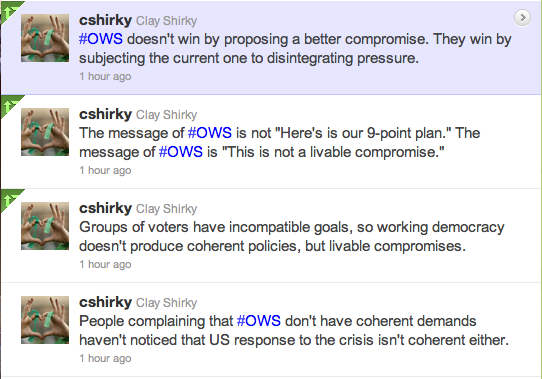
People complaining that #OWS don’t have coherent demands haven’t noticed that US response to the crisis isn’t coherent either. (link)
Groups of voters have incompatible goals, so working democracy doesn’t produce coherent policies, but livable compromises. (link)
The message of #OWS is not “Here’s is our 9-point plan.” The message of #OWS is “This is not a livable compromise.” (link)
#OWS doesn’t win by proposing a better compromise. They win by subjecting the current one to disintegrating pressure. (link)
This is exactly right. I don’t know if #OccupyWallStreet will ever put forward a specific prescription that they want to see realized for all the ills documented in the Declaration of the Occupation of New York City. But I would hope that they just keep the occupation going and keep making clear that “this is not a livable compromise.” Stoller’s analysis quoted above exposes the ways in which current professional organizing and political party structures fail to recognize that we aren’t getting a “livable compromise.” While it’s incredibly encouraging that so many labor unions, progressive organizations and community groups have stood with the #OccupyWallStreet movement, there’s still a fundamental, underlying tension here. It may not be a relevant one as long as all groups do is stand alongside #OccupyWallStreet, but it could become a bigger problem down the road.
In the mean time, I strongly encourage people to embrace the logic of Shirky’s argument and stop asking for the #OccupyWallStreet movement to do things they way you are used to seeing them done. Let this movement be and see how much power pure and articulate complaint have as a force for creating the conditions needed for change.
Good video on #OccupyWallStreet
Great video by DC Baxter about the #OccupyWallStreet movement and some specific changes that he would like to see from a policy perspective.
- Reinstate Glass-Steagall
- Audit the Fed
- Repeal corporate personhood
- Overhaul the top 1% and corporate tax codes
These are all ideas which, from what I can tell, would likely be appealing to the people at #OccupyWallStreet. But I don’t see these specific policy proposals coming out of the NY General Assembly yet, so I’d be hesitant to say they’re representative of the whole phenomenon.
 Hold Fast