MAGA vs Reality

I was discussing with some very smart friends the critical question of if Trump’s $6 trillion tax increase in the form of chaotic tariffs might be beyond the power of the rightwing media to spin in favorable terms. Could this event – which likely will precipitate a global economic collapse and massive pain in Americans’ finances – that causes the Trump/MAGA fever to break? Is it something that simply cannot be explained away, blamed on trans kids or DEI?

My short answer is: I’m not sure. I think the rightwing reality popping moment that tested their information ecosystem was Covid and it killing over a million Americans.

The response was “DERP vaccines are the real killer” and arguably a massive acceleration towards Know Nothing anti-science, anti-constitution, election denial insurrection. It undoubtedly took the epistemic schism between right and center news ecosystems and exploded it into a seemingly irreparable rift that threatens the existence of America as a project today.

Maybe total economic destruction challenges that more fundamentally than people’s families dying in ERs while coughing out “but Covid isn’t real” with their final breaths. But maybe it won’t.

Studies late on in the pandemic showed that 54% of Americans knew someone who died of covid. The number shot up to over 70% if you included “or was hospitalised” from Covid. This was an event that affected people directly in the worst possible way and it did not cause the American right to revisit what they thought was true.

A massive recession could be worse, in terms of it directly impacting more people, at a higher level of inconvenience, than Covid did. But I would not underestimate the ability of rightwing media figures and politicians to continue to find ways of misdirecting truth and responsibility from Trump and his flunkies. The MAGA epistemic bubble is large and it is robust. The amount of pain that may have to be felt before it is popped likely is unfortunately large.

La Pausa

Since the election, I have wanted to write. I have wanted to quickly move forward with answers as to what has gone wrong, what Democrats could have done differently, what should happen next. Now Donald Trump is about to be inaugurated for a second time. While I think the picture as to what has happened has improved, I don’t think I yet know exactly what should come next.

~

In soccer there is a tactical concept that has become popular in the last few years. It’s call La Pausa and it entails a team in possession of the ball – usually a central defender or a goalkeeper – standing still, with the ball at their feet, and waiting. The team without the ball has likely dropped off, wanting to compress the space they have to defend. But with La Pausa, the defending team is forced to come out of their shape. In so doing, the player with the ball can now see a different set of options, a more favorable set of options as to what to do next.

La Pausa can be infuriating to watch. It lacks urgency. It isn’t satisfying. It doesn’t make you feel like your team is doing what needs to be done. But time progresses, things shift, and suddenly the right choices appear.

Of course it is something that is done when your team is in possession of the ball. When the other team has the ball, your team must still react to it, to try to get the ball back.

I keep coming back to this concept of La Pausa as I think about America and what progressives need to be doing now to best understand what happened in November and what we should do next.

~~

There are two modes that progressive activists and the Democratic Party should be in right now: resistance and reflection.

Trump and his agenda needs to be resisted. Full stop. He will try to do horrific things to vulnerable people – we should not let him. He will try to undo good policies from Biden and Obama – we should do what we can to stop him. There will be times where mass mobilisation is needed to show resistance to the Trump agenda. There will be times where direct actions are needed to resist. There will be times where community organizing and legislative advocacy are needed. Now is not the time to sit idle, nor wait for the 2026 midterms, nor wait for an invitation to resistance.

But while that is happening in the moment, there must also be reflection. Not panic based on exit polls. Not rushing to confirm prior held beliefs of pundits and center-right Democrats. Democrats did face a significant electoral loss. Even if the absolute numbers are by no means historic in nature, the consequences of MAGA Republicans controlling the White House, Senate, House and Supreme Court are going to be dire. Democrats and their coalition must develop an earnest understanding of how this failure happened and what can be done to course correct.

Partly this may be about the policies that are pursued. Partly it may be about the language used to talk about Democrats’ policy goals. But there must be a degree of sophistication in the analysis and an investment in trust.

I firmly believe that America can be a place where vulnerable people are protected, where everyone can be cared for and find dignity in their lives, where people are welcomed and accepted. I believe that we can hold strong in our values of diversity, equality and inclusion because it makes us all better. And I believe we can talk about these values and these aspirations in ways that are fundamentally appealing to all sorts of people in America.

~

When it comes to what Democrats or progressive groups should be doing now, though, other than resistance, I think time is an asset for strategy. Lacking any substantive influence to proactively advance policies through the federal government, taking a moment to land a coherent, intentional strategy feels sensible.

Inevitably a second Trump administration, in addition to being vile and a fundamental assault on American values, will be chaotic and incompetent. Left to his own devices, Trump will advance policies that hurt the economy, destroy jobs, increase inflation, and siphon wealth from the rest of us to the richest people and corporations. Voters will have the opportunity to quickly look around and see that Trump and the Republican Party’s rule is not what they were sold in this past election. As these things happen, the political landscape will shift and the options available to Democrats and their allies will look different. Perhaps even more favorable.

Today Republican’s power feels overwhelming. But it will shift, likely quickly, and with the shifts new opportunities to start winning again will come. La Pausa is relevant.

I have mixed metaphors and concepts here. This soccer metaphor is a clumsy heuristic for understanding American politics and power. But the need to simultaneously be reactive to crises and be attentive to longer term strategic evolutions is an essential demand for the moment we are in.

Resist, today and tomorrow and at every turn needed. But do so while building a deeper sense of how to navigate forward, proactively growing power and adapting to the changing landscape so that we can turn back from this terrible place and bring people to a brighter future.

Solidarity Against Trump’s Austerity Death Trap

Screen Shot 2020-03-24 at 4.20.08 PM

Amidst the fear and pain of the Coronavirus pandemic, the one thing that has given me hope is how people have come together in response – meeting the needs of the moment with togetherness instead of panic. There are countless mutual aid efforts happening around the world and incredibly bravery from frontline medical staff. People sing out their windows together in Italy to give each other hope. People bang pots and pans together out their windows in Brazil to protest the inadequacy of the government’s response.

In the US, all signs point to the Trump calling people back to work next week in the face of all medical advice. Conservatives are lining up with takes that suggest the death of a few percent of the population – hundreds of thousands to millions of people here in America – are less bad than the collapse of the whole economy. Trump thinks a crashing economy is worse for his political future than mass graves. (Let’s leave aside the absurdity that an attempt to restart the economy would survive a million dead Americans, or that Trump even himself stopped the economy to begin with). Carl Beijer has called this Trump’s austerity death trap and I think that captures it well.

Already online there is talk that workers should go out on general strike if Trump tries to force people back to work. My fear is that while the labor movement may not be strong enough to support this, many people will make the hard individual choice that indeed their lives and their families lives are more important than their jobs. They will put some degree of faith in the government to provide direct aid and some faith that they can get by on charity, on credit, and on personal austerity. They will bravely do the thing that is obviously right, but their President (and surely soon, the conservative media and their bosses) is telling them is wrong.

It is critical that people who say no to Trump’s prioritization of the economy over human life feel supported. It is critical that people do not feel alone in this decision, that they not feel shame in their abstention from work. It is critical that space is created for not only people to refuse this demand to keep the gears of the US economy going with the lives of working people.

There is a critical opportunity to both support people and encourage them to make the right decision and create the tools to help spread this reaction – whether we call it a general strike, an abstention, a non-cooperation movement against Trump’s deadly self-interest. What we need is visual and cultural signifiers to share. Not just badges and memes on social networks, but something local and offline.

I’m not a visually creative person. My first thought of a white bedsheet out a window probably has the wrong connotations but is the sort of thing that could be done by almost anyone in the world. A white bedsheet with a painted green slash could provide a solution. The green ribbon is being used in southeast Asia alongside the hashtag #WeWillOvercome. And the color does tell the story of the sort of recovery we want (be it a green stimulus or a green new deal or both)!

I don’t know if Trump will press Americans back to work. I do know that if he does, it will likely result in the rapid spread of the coronavirus and a massive increase in human suffering here in the US, at minimum. This is a terrifying moment, the worst imaginable outcome of putting a selfish, stupid, incapable man in the White House.  But in the face of this stupidity, we are not alone. We have each other and we have common sense.

There never really was mass resistance to Trump’s presidency. If there ever will be, this feels like the moment where it will emerge – beyond twitter and across our communities. The irony is now it cannot be in the streets, but must be online and in socially distant ways offline, too. That’s why I see value in a finding a unifying visual meme to connect those who will together reject Trump’s attempt at mass murder at the alter of the economy.

The Civic Upswell

Eric Liu has a piece in The Atlantic that looks at the civic upswell that’s happened in response to Trump. It’s overall encouraging, celebrating that “people are exercising both power and character.” It’s optimistic in a dark time.

This line is something I might be skeptical of:

“The surge will likely outlast his presidency. Americans today are rushing to make up for decades of atrophy and neglect in civic education and engagement.”

Let’s say something – Russia, lying about what he knew, corruption, emoluments, being certifiably crazy – forces Trump from office, either with impeachment or resignation or removal under the 25th Amendment, Section 4. In that case, Mike Pence would become president. Pence is just as extreme a conservative as Trump, if not more. However Pence speaks the language of civil governance. He doesn’t tweet crazy things. He sounds like any other politician.

My fear is that even if Trump is removed from office (which I want to see happen!), the removal of the tangibly insane thread from conservative governance would quell the popular civic outpouring that is currently taking place.

Pence would feel normal, even if he still pursuit draconian immigration/deportation policies, gutted social programs and took a bellicose posture towards Iran, China or Russia. The normality, the leveling-down of extreme policies by the press because of being more normal than Trump, would be a cold splash of water on the current civic upswell.

It would be up to us as organizers to keep it going, but it would be far less self-sustaining and require even more coherent, intentional organizing.

The Hard Work of Change

In Jacobin, Alex Gourevitch has an interesting article challenging the resistance movements that are emerging in response to Trump to be sure to include a positive vision for the world we want to see.

I’m seeing frequent references on the Left to the need to do real politics; to build power through slow, hard work; to organize in impacted communities; to not attempt to take shortcuts to achieving mass actions. All of this is correct and worth noting. That’s why the start of Gourevitch’s article is frustrating to me:

Under Obama, Occupy squandered the initial hopefulness and general appeal when it let procedural squabbles sap its energy and undermine its potential for a real political intervention. No wonder there was little public support when the police showed up. The resurgence of activism associated with the Black Lives Matter movement marked another significant moment for the American left but, despite three years of protest and consciousness-raising, public attitudes towards the police have improved and there are few balancing accomplishments to point to.

These are valid objections to make, yet they miss that many of the things which have grown out of Occupy still exist. Mutual aid projects like Occupy Sandy, Occupy Our Homes (especially in Atlanta and Minneapolis), and Strike Debt did just the hard work we see demanded of now – and it paid off with sustained engagement and local presence.

Elements of grassroots political power that formed in the crucible of Occupy were there supporting and accelerating Black Lives Matter. Dream Defenders and the Wildfire Project immediately comes to mind, as does the persistent community-based organizing from Occupy Our Homes in Minneapolis and Atlanta. Local groups from BLM and OWS are out front in organizing the response to Trump, including through the Indivisibles and the Women’s March.

None of this necessarily amounts to sea-change in the political landscape, but it does speak to the ongoing hard work by people committed to create change through organizing in impacted communities. You can’t look at Occupy or Black Lives Matter and say that they failed to build power simply because they didn’t succeed in achieving all of their goals full-stop. It’s an unfair and unrealistic expectation that every movement that emerges in response to a major disruption be immediately capable of delivering lasting transformative change, especially when so few organic popular outbursts, let alone well resourced strategic ones, have reached this level of success in the US. This is and was what the hard work of organizing is about, these movements did it and there’s something to learn from them, and why they didn’t achieve their goals even while doing the sort of organizing that many from the Left want to see today.

I’m starting from a somewhat negative stance on Gourevitch’s piece simply because I feel these are comments worth making, not to disqualify where he goes with his evaluation of what we’ve seen from the Trump resistance so far. He writes:

The point here isn’t to bash the Left; it’s to take a sober look at the opportunities and limits we face. The truth is, this should be our moment. The Trump administration and Republican Congress are a fragile entity, whose control of the state rests less on mass support and more on the undemocratic features of our institutions.

Trump received a minority of the popular vote, the fifty-two Republican senators in Congress represent 44 percent of the population, and the eight-soon-to-be-nine ghouls in Supreme Court robes are even more insulated from actual majorities. Moreover, there are all kinds of internal divisions among Republicans on how to handle everything from health care to immigration. To the degree that Trump and the Republicans look like an unflinching, reactionary juggernaut it is because there is so little organized power to stand in their way.

This is exactly right. Admitting that moments that have felt transformative, but failed to be so, isn’t an attack, it’s the truth. There’s plenty that we should be encouraged by right now. And as I noted above, I still see much from OWS and BLM that indicates a positive direction of travel, if not outright victory.

Gourevitch raises a critical point regarding how the Left has actually tended to sit outside of the political realm, using only direct action tactics to have impact, while avoiding more traditional mechanisms.

[T]he downside of direct action is that it has often served as a tacit admission of the Left’s inability to translate social power into political control. The Left has generally been on the outside looking in and its celebration of direct action put it in static rather than dynamic opposition to the corruption and opportunism of existing parties.

Direct action is critical in terms of forcing people to think about the crises before them and respond beyond business as usual. But the whole point is that it occurs in a place of harm, at a moment when politics have failed. He goes on:

We can field thousands, sometimes tens of thousands, even occasionally hundreds of thousands, and then be safely ignored. We call it resistance, but any exercise of our agency that isn’t total cooperation with the status quo looks like resistance. It contains no internal measure of success or failure, which is why it is compatible with retreat or even resignation. And while it is “mass” politics in the sense of many people, protests do not require anything like the ongoing commitment to principle and organization that something like party politics does.

Our unwillingness to admit our own weakness is the flip side of not having a clear set of principles that can serve as the basis for a mass movement. Instead, we give ourselves the appearance of unity and purpose by resisting evil and by taking our collective “No” out into the streets. We find comfort in knowing that we are not them, that at least we are doing something. Trump is immediate and present, the evils are right in front of us, numerous, and ready-to-hand.

Being for something is the key counterpart to resistance and mass mobilization against Trump (or his corporate backers). The prescription is freedom:

The better principle is freedom. It is the interest everyone has in being free from the myriad forms of domination and oppression that most people face, and it is expressed by being part of a movement that seeks to transform society. Freedom is something everyone wants, but can only be achieved if we demand it and pursue it jointly. It is a principle that naturally bridges all those aspects of left politics that otherwise separate us. We are divided by the varieties of oppression and the proliferation of identities that are born out of that oppression, but we can be united by the desire for freedom.

Less abstractly, freedom is the principle that explains and unifies what we are for. We are more than being against Trump, racism, sexism, inequality, etc. We are also more than a list of demands, like universal health care, cheap and legal abortion, open immigration. We are only for those things to the degree that they are all the same thing: freedoms that everyone ought to enjoy.

The positive vision for society, through the lens of freedom, creates a powerful way to connect to those who are in the streets resisting, just as much as it does to those who didn’t feel energized to go out and vote in November, just as much as it does to those who felt attracted to Trump.It has a strong grounding in basic human needs and desires. It’s a strong organizing principle, one that can safely nurture and grow our intersectional values of equality, fairness, safety, and health. It’s a clear lens that can be used to condemn and resist against Trump’s agenda.

What’s more, while it may not sit as an articulated list of demands on many organizational websites, I’d hazard that you can ask most people who are resisting Trump what freedom means to them and you’d find it’s strongly oriented around similar real-world applications on a range of issues.

Gourvetich’s whole piece is worth reading in full. We’ve seen a lot of criticism of mass mobilizations under Trump so far and while he does make some fundamental critiques of where past disruptive movements failed to achieve lasting change, he provides a pathway towards hope in this moment. It’s certainly a start.

The Fast Pace of Trump

It’s terrifying to think that the Trump era has only been going on for two weeks and two days. It feels like it’s been months already. A huge part of this has been due to the breakneck speed that Trump has launched himself into office. Almost every week day has brought a major new executive order or foreign policy action that shakes the country with its severity and radicalism. From a Muslim ban, to reauthorizing Keystone XL and the Dakota Access Pipeline, to pulling out of TPP, to pulling back environmental regulations, every day we are regularly seeing transformational actions emerging from the Trump White House.

And that’s just the things that are definitively happening – the rumors of what could come next, from a national right-to-work (without job security) push to gutting federal LGBT protections, are pouring out just as fast. Other intended massive initiatives, like the repeal of the Affordable Care Act or building a wall on our border with Mexico, have been announced but only seen limited concrete progress.

The press isn’t prepared for the pace of action. The Democrats aren’t prepared for it. And civil society groups responding to Trump are finding themselves pulled in every direction at once by the pace of Trump’s actions.

Of course what we’re seeing Trump and his team actually do is actually exactly what he said he’d do as a candidate. He is rapidly checking off as many boxes as possible when it comes to keeping his promises from the campaign. We are just historically unprepared for this sort of directness. Obama and Bush both moved primarily through legislative actions in their early days. Their executive orders tended towards less transformational actions.

I see two potential explanations for Trump’s governing behavior, which has largely avoided anything requiring congressional action.

The first and potentially more reassuring explanation is that Trump, Bannon, and the rest of his political team are going with a realpolitik  political strategy. They want to be able to say to their base and to the country on whole: We were elected. We kept all of our promises. And when these executive orders and actions inevitably get rolled back or reduced by either legal proceedings or congressional action, they’ll be able to point a finger and say, “See, it was the corrupt judges. It was the crooked establishment. It was just like I said when I was a candidate. I kept my word and they are to blame for where we stand now.”

This explanation makes sense if the Trump team is comfortable spending a lot of time litigating their actions. They maybe don’t care about their policies being fully realized, as much as being able to tell a story that helps them win re-election. It is a cynical, yet arguably sharp, political plan.

The second explanation for the Trump executive action blitz is significantly more scary. Instead of being based on a political-electoral analysis, Trump and co. are actually governing in the manner that they see the presidency functioning. They want to act quickly because they think they are the sole decider of American policies and laws. They act without consulting Congress or even cabinet officials and staff at agencies like DOJ, DHS, DOD or State. They don’t think they need bureaucrats and experts to craft legal orders. They don’t need to consult people with deeper knowledge than that possessed by a TV entrepreneur, an editor of Breitbart, and an small-time publisher. They are in charge and they aren’t interested in waiting for others to weigh in.

The scary part of this is that it speaks towards an authoritarian orientation towards governance, one that is incurious and insulated. We saw inklings of what may happen when border patrol officers refused to honor judges’ decisions to suspend the Muslim ban last week. We saw it again this weekend as Trump took to twitter to blast a “so-called judge” who happened to issue a ruling against him. When this administration and their staff refuse to follow the orders of a co-equal branch of government, we enter a real constitutional crisis.

The actions of Trump, Bannon, Miller and others are truly terrifying. They have not displayed any competence in a traditional sense. However their pace of action and its extreme nature not only make up for the general incompetence of implementation, but ensure that many of the bad things they are trying to rush through will become realities in the end.

Either Trump is politically astute and positioning himself for four years of war against the establishment or he’s a genuine authoritarian who will govern through constitutional crisis. In either regard, he is and will continue to implement terribly destructive policies that cause real human suffering.

I’m not sure if Trump’s strategy is particularly relevant to how Democrats or the Left respond to him right now, at least not on a case-by-case basis. But as we get greater clarity on the direction of travel he’s moving down, the more relevant it becomes. A politically expedient desire to keep campaign promises quickly then spend four years pointing fingers at the establishment stopping them from being fully realized would suggest we just have to weather the storm now.  In contrast, a strong turn towards authoritarian, ignorant rule from the White House would suggest a real risk for the 2020 election being something Trump would accept if he lost. And that should be enough to make one’s blood run cold.

Supporting resistance

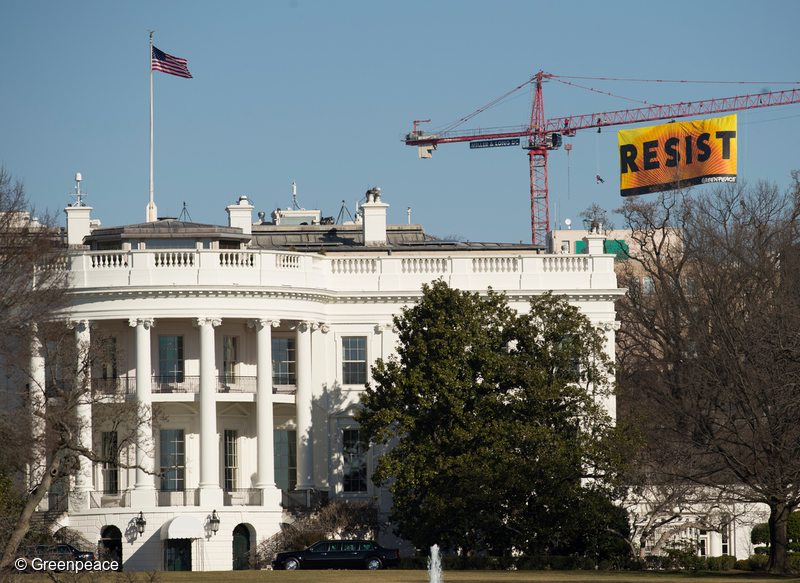
resist

I’ve been an activist for half my life at this point. When I was in high school and college, going to marches and protests really fired me up. It was the realization of grassroots, campus-based organizing I was doing. It felt awesome and empowering. But once I because a full-time activist and organizer, I got over it. It got old. I don’t get excited about protests. I don’t go to them unless I really have to, it just doesn’t do it for me. I get enough from my day to day organizing work to feel like I’m making a contribution without having to be physically present at a protest or rally.

But marches and protests aren’t actually for me, not the me of today. They’re for the high school and college me, the one who may only have one afternoon a week or one day a month to be able to make a full political statement with my body, my time, my voice. I get it if you are cynical about mass mobilizations. I get it if you don’t see the value of marches from your perspective as a professional activist or organizer, as this is often a hub of cynicism when it comes to physical action. But they’re not for you, they’re for the people who don’t have jobs dedicated to change-making in a full time way (which is to say, they’re for almost everyone else in the country).

Last weekend’s women’s marches were big and bold and inspiring. People came out because they care about what is happening in America and want to resist against it. It was a loud statement of our values and such a needed one. These marches are helping people struggle through dark times. They are creating a vibrant, visual resistance to Trump. They are bringing millions of people into political engagement. They are 100% exactly what we need right now, because they will make so much of what comes next possible.

Senate Democrats aren’t going to save us. House Democrats aren’t going to save us. MSNBC isn’t going to save us. None of our tweets are going to save us. We are going to save us and the people showing up at these marches and protests are the “we” I’m talking about.

Let’s find was to build, inspire, grow these marches. For professionals like me, let’s lend our professional talents and tools to empower and enable the people in the streets. Let’s do that even more as people move from attending marches and protests towards building new organizations, local organizations dedicated to resisting against Trump and defending our values.

Charles Pierce on Sanders, Clinton & Trump

Charles Pierce is on point here about the why and the how Sanders has made the primary race with Clinton a close fight:

The simple fact is that, if HRC has lost her lead at the moment, she has lost it to a superior campaign.

And it’s not as simple as the “populist anger” narrative would have you believe. Sanders has been running a 50-state campaign since before he formally declared his candidacy. He went to South Carolina. He went to Mississippi. He drew large and approving crowds in both places. He has stayed doggedly on message, directly refusing to help the elite political class in its pursuit of shiny objects. He repeatedly has emphasized that the pursuit of his policy goals, which all have to do with breaking the power of impending oligarchy and its threat to self-government, cannot be limited simply to electing him. And that’s where the easy narrative falls apart.

Pierce goes on to explain how Sanders’ populism is distinct from Trump, a meaningful difference in a media environment seeking easy answers for what the Beltway press finds to be two inexplicable campaigns:

Sanders punches up at the elites that, frankly, have more power in our politics than he does, or than you do, or than any politician does. He tells his audiences that he can’t do it alone, that the money power has grown too great for any one person to combat. He needs them more than they need him. He is not Napoleon, he is a democratic politician. And that makes all the difference and that’s why the “populist anger” narrative is a shuck. Anyone who says they could vote for either Bernie Sanders or He, Trump has been living for the last nine months with their head in a laundry bag.

The respective appeals of the two men are similar only on the simplest and least consequential levels. On the most profound levels, the two campaigns couldn’t be more different. Bernie Sanders is where he is because the positions and the policies he has been championing all his career have come back somewhat into favor ever since some grifters broke the world economy and then made off with the rubble. That is why he’s different from Donald Trump and that is why Hillary Rodham Clinton is noticing that things in the rear-view window are closer than they appear.